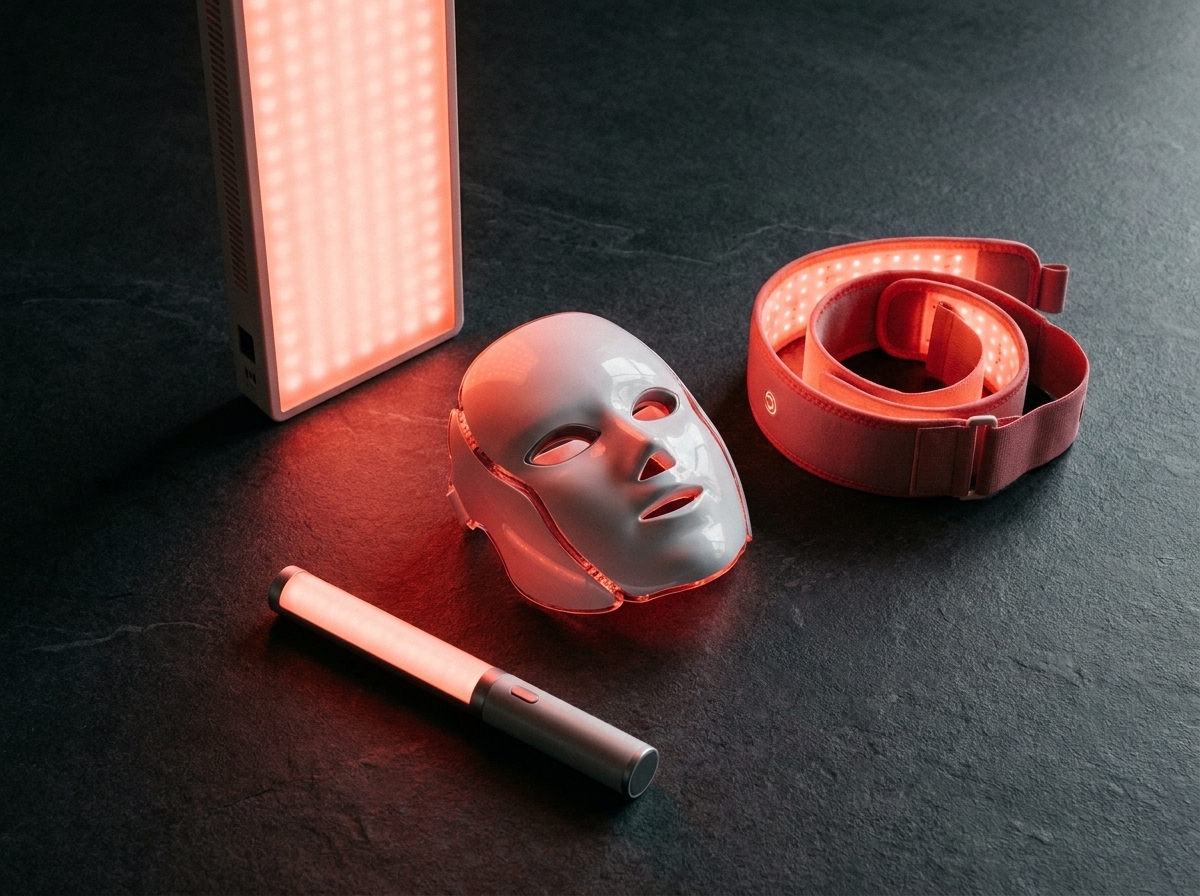
Red Light Therapy Panel vs Mask vs Belt vs Wand: Choose Right
Medically reviewed by the Royal Wellness Medical Advisory Board · Last reviewed May 2026 · 9-minute read
Quick Answer
The right red light therapy device depends entirely on your primary goal: full-body panels for athletic recovery and multi-goal use, face masks for skin rejuvenation, belts and wraps for chronic joint pain, transcranial helmets for brain photobiomodulation. Picking the wrong format means either wasted sessions (light cannot reach the tissue you care about) or wasted money (overpaying for capability you do not use). For most users with mixed goals, a full-body dual-wavelength panel is the smartest single device.
Key Takeaways
·Full-body panel: athletes, multi-goal users, full-body wellness
·Face mask: skin-only goals, anti-aging, drives consistency
·Belt/wrap: chronic joint pain, lower back, knees, shoulders
·Wand/handheld: spot treatment, travel, budget-constrained
·Specialty helmets: brain photobiomodulation (dedicated 810 nm)
At a Glance: Key Facts and Statistics
·Full-body panel coverage: 24–48 inches treatment area
·Face mask treatment time: 10 minutes hands-free per session
·Belt direct contact advantage: higher effective irradiance vs panel
·Wand session time: 1–5 minutes per spot
·Helmet purpose: transcranial 810 nm only
·Price range for panels:
3,000
·Price range for masks:
800
·Price range for belts:
700
·Price range for wands:
500
Medical Disclaimer: This article is for educational purposes only and is not medical advice. Device recommendations should align with your specific health goals and any medical conditions. Consult your physician before starting a new wellness protocol.
Four Device Types, Four Different Jobs
Red light therapy devices are not interchangeable. Each format optimizes for a different combination of coverage, convenience, and irradiance. Picking the wrong one means either wasted sessions or wasted money.
The framework that works: match the device to the tissue you need to reach, and the consistency you can realistically maintain.
For format-agnostic dosage information, see the red light therapy dosage protocol guide.
Full-Body Panels
Best for: athletes, full-body wellness, biohackers, multi-goal users.
How they work: vertical or horizontal panel (24–48 inches tall) emitting light across a large treatment zone. You stand, sit, or lie in front of it, rotating to cover front and back. Session times typically 10–20 minutes total for full-body coverage.
Pros:
·Highest irradiance available in consumer market (100–160 mW/cm² at 6 inches in premium models)
·Multi-purpose: skin, recovery, joints, general wellness in one device
·Lowest cost per treatment over time when amortized across goals
·Best for athletes training daily
·Most flexible — adapt to any body area by positioning
Cons:
·Largest footprint — requires dedicated space (2–3 sq ft minimum)
·Highest upfront cost
·Sessions require active positioning and rotation
·Less convenient than hands-free options for daily use
Choose if: you want one device for all goals, have $1,500+ to invest, and have space for a stationary panel.
For panel-specific recommendations, see the best red light therapy panel buyer's guide.
Q: Is a full-body panel worth the investment? A: For users with multi-goal use cases (athletic recovery + skin + general wellness) and daily session commitment, yes — the cost amortizes faster than mid-tier replacement cycles over 5 years. For single-goal users (face only, knee pain only), a specialty device typically delivers better results per dollar. The panel is the right choice when versatility matters more than format optimization.
Face Masks
Best for: skin rejuvenation, anti-aging, acne, rosacea.
How they work: rigid or flexible mask with embedded LEDs ($300–800). You wear it for 10 minutes, hands-free, often in combination with skincare. Conforming designs ensure even facial coverage.
Pros:
·Hands-free — drives consistency, which is the biggest predictor of skin results
·Even coverage of facial surface
·Pairs naturally with skincare routine (do during evening serum application)
·Travel-friendly
·Single-purpose, low decision friction
Cons:
·Limited to face (some include neck and decolletage)
·Lower total light output than full-body panels
·Cannot address body, recovery, or joint goals
·Single-purpose limits cost-effectiveness for multi-goal users
Choose if: skin is your only goal and consistency is your bottleneck. Masks have closed the irradiance gap with panels significantly in 2026 generation devices — for face-only goals, a mask often outperforms a panel in real-world results because consistency beats power.
For skin protocols, see the red light therapy for skin guide.
Q: Should I get a red light therapy mask or panel for my face? A: For face-only skin goals, a mask is the better choice. The hands-free design drives 5x/week adherence in ways that panels often do not — and consistency beats power for skin outcomes. For multi-goal use (face plus recovery, face plus body), a panel is more cost-effective long-term.
Belts and Wraps
Best for: targeted pain, joint issues, abdominal use, lower back, knees.
How they work: flexible LED-embedded belt ($200–700) that wraps around the treatment area. Direct skin contact means higher effective irradiance reaches the target tissue than panel-based delivery from 6+ inches away.
Pros:
·Direct contact = highest effective irradiance for the target area
·Targets specific pain points precisely (knees, lower back, shoulders, hips)
·Hands-free during sessions (wear while reading, working, watching TV)
·Portable, easy to use anywhere
·Excellent for chronic localized pain
·Often more cost-effective than panels for single-area pain
Cons:
·Single-zone treatment per session (one knee, one shoulder, etc.)
·Lower total surface area covered than panels
·Less useful for general wellness or multi-goal use
·Cannot replace a panel for full-body recovery
Choose if: you have a specific chronic pain area (knee osteoarthritis, lower back pain, frozen shoulder, recurring tendinopathy) or want a portable solution that targets your problem area.
For joint-specific protocols, see the joint and back pain guide.
Q: Is a red light therapy belt better than a panel for back pain? A: Often yes. Belts deliver direct skin contact, which produces higher effective irradiance to the target tissue than a panel positioned 6+ inches away. For chronic localized pain (lower back, knees, shoulders), the wrap-around design also ensures even coverage of the joint or muscle group. Panels work for back pain but require lying face-down with deliberate positioning — belts deliver more consistent dosing with less setup effort.
Wands and Handhelds
Best for: spot treatments, intermittent use, travel.
How they work: small handheld emitter ($150–500) held over the treatment area for 1–5 minutes. Most appropriate for acne spots, small joints (fingers, wrists), or quick targeted applications.
Pros:
·Lowest cost entry point
·Portable, travel-friendly
·Good for spot treatments (acne, small joints)
·Useful as supplement to a primary device
Cons:
·Hands-on — sessions feel laborious
·Lowest treatment area per session
·Inconsistent positioning reduces effective dose
·Not suitable as a primary device for serious goals
Choose if: budget-constrained, you only need occasional spot use, or as a complementary device to a primary panel or mask.
Hand fatigue is the most common reason wand users abandon their devices. For any goal requiring 5+ sessions per week, a hands-free option (panel or mask or belt) almost always produces better adherence and results.
Specialty Devices: Helmets and Caps
Best for: brain photobiomodulation, hair loss treatment.
How they work: densely-packed LED arrays designed specifically for cranial coverage. Helmets ($1,500–3,500) typically deliver 200+ individual LEDs for even coverage. Hair growth caps use 650–680 nm LEDs for follicle stimulation; brain helmets use 810 nm for cortical penetration.
Pros:
·Purpose-built coverage that panels cannot replicate for the scalp
·Hands-free during sessions
·High LED density ensures even cortical or follicular dosing
·810 nm helmets are uniquely suited for transcranial applications
Cons:
·Single-purpose (cannot serve other goals)
·Higher cost than general devices
·Bulky compared to other formats
Choose if: you have a specific scalp-related goal (hair growth) or are pursuing transcranial photobiomodulation (cognitive performance, post-concussion recovery, depression adjunct).
For hair-specific applications, see the red light therapy for hair growth guide.
For brain photobiomodulation, see the brain photobiomodulation science guide.
Decision Framework
Match the device to your goal:
·Athletic recovery (full-body): Full-body panel
·Anti-aging skincare (face): Face mask
·Anti-aging skincare + recovery: Full-body panel
·Knee or back pain: Belt or wrap
·Knee pain + general wellness: Panel + belt combination
·Acne (localized): Mask or wand
·Hair growth: LLLT cap or helmet (specialty)
·Brain support: Transcranial helmet (specialty)
·Whole-body wellness: Full-body panel
·Travel-friendly only: Wand or compact belt
·Maximum versatility: Full-body multi-wavelength panel
·Single-goal optimization: Specialty device for that goal
Q: Can I use one device for skin and muscle recovery? A: Yes — a dual-wavelength (660 + 850 nm) full-body panel addresses both. Use 5 minutes facial work plus 10–15 minutes body work in one session. This is more cost-effective than buying separate face and body devices, and works well for users with multiple goals. The trade-off versus a dedicated mask is convenience — panels require active positioning while masks are hands-free.
Stacking Multiple Devices
Many serious users own two devices that complement each other:
·Panel + mask: broad benefit (panel) plus daily skin consistency (mask)
·Panel + belt: general wellness plus targeted joint relief
·Mask + cap: face plus scalp (skin + hair) in one daily routine
·Helmet + panel: brain photobiomodulation plus general body benefit
The two-device stack often costs less than a single top-tier flagship while delivering broader real-world benefit. The key is matching each device to a specific goal rather than buying overlap.
Common Mistakes by Format
Buying a wand when you needed a panel. Hand fatigue kills consistency. If you have multiple body areas or need sessions of 15+ minutes per area, a panel or belt outperforms wands.
Buying a mask without verified wavelengths. Marketing photos often show blue or amber LEDs that look therapeutic but are not. Verify 660 nm or 830 nm peaks before buying.
Buying based on LED count alone. A panel with 800 weak LEDs underperforms one with 400 medical-grade LEDs. Density without quality is meaningless.
Buying a belt for general wellness. Belts excel at targeted joint or back pain. For general wellness, a panel is more appropriate.
Buying without warranty consideration. Fans and drivers fail. A 5-year warranty signals manufacturer confidence; a 1-year warranty signals expected failure.
Buying a wand expecting panel-level results. Wands work for spot use but cannot replace a primary device for serious goals.
Cost-Effectiveness Comparison
A rough framework for cost per session over 5 years (assuming daily use):
·**Premium panel (
0.55 per session
·**Mid-tier panel (
0.27 per session
·**Premium face mask (
0.33 per session for face goals
·**Belt (
0.22 per session
·**Specialty helmet (
0.98 per session
The "expensive" premium panel actually delivers a low cost per session when amortized — assuming you use it daily. The expensive option becomes expensive when underused.
Glossary: Device Format Terms
Full-Body Panel: Stationary panel designed for full-body or large-area light therapy. Typically 24–48 inches tall.
Face Mask: Conforming device covering the face with embedded LEDs. Hands-free during sessions.
Light Therapy Belt: Flexible LED-embedded belt designed to wrap around joints or large muscle groups. Direct skin contact.
Light Therapy Wand: Small handheld emitter for spot treatments. Limited treatment area per session.
Transcranial Helmet: Specialty device with dense 810 nm LED array designed specifically for brain photobiomodulation.
LLLT Cap: Specialty device with 650–680 nm LEDs designed for scalp hair growth applications.
Coverage Area: The treatment zone where irradiance remains therapeutic. Differs significantly by format.
Direct Contact: Device positioning where the LED surface is in direct contact with skin (belts, wraps). Higher effective irradiance than panel-based delivery.
Hands-Free: Device operation that does not require continuous user effort. Drives adherence.
Multi-Goal Device: Device that can address multiple goals (typically full-body panels). Versatile but less optimized than single-purpose devices.
Single-Purpose Device: Device optimized for one specific goal (mask for face, helmet for brain, belt for joints). Less versatile but often more effective per session for that specific goal.
Frequently Asked Questions
Can I use a panel for face-only goals?
Yes, and it works. But a mask delivers more consistent positioning and is often used more often — which beats higher power used less. For face-only goals, the mask is the better choice. For multi-goal use that includes face, a panel covers face plus everything else.
Are belts as effective as panels for back pain?
For back pain specifically, often yes. Direct skin contact and wrap-around coverage compensate for lower total light output. The localized direct-contact irradiance of a belt often exceeds what a panel delivers to the same area from 6+ inches away.
Which format is best for beginners?
For broad benefit, start with a face mask (low commitment, hands-free) or a mid-tier panel ($400–800, broad utility). Avoid wands as starter devices — hand fatigue kills consistency, and consistency is the biggest predictor of results.
Can I use red light therapy devices in combination?
Yes — and many serious users do. Common combinations include panel + mask, panel + belt, mask + cap. Two complementary devices often cost less than one flagship and deliver broader benefit.
What about handheld masks (semi-rigid mask devices)?
These exist and work, but the rigid full-face mask format generally outperforms semi-rigid for consistent positioning. The difference is small for most users.
How do I know my device emits the wavelengths it claims?
Look for spectrometer-verified specifications in product documentation. Reputable manufacturers publish measured peak wavelengths (typically 660 ± 5 nm and 850 ± 10 nm). Avoid devices that list only a wavelength range without specific peaks.
Should I prioritize coverage or irradiance?
Irradiance first. A device that does not deliver therapeutic irradiance is useless regardless of coverage. After irradiance threshold is met (70 mW/cm² minimum for any clinical work; 100+ for serious goals), more coverage is the next priority.
Can I travel with my red light therapy device?
Wands and compact masks travel best. Compact panels (12–18 inch models) work for car travel. Full-size panels are not realistic to travel with. Belts pack reasonably for travel if needed.
References
1.Cleveland Clinic — Red Light Therapy: Benefits, Side Effects, and Uses. Available at: my.clevelandclinic.org/health/articles/22114-red-light-therapy
2.Hamblin, M. R. (2017). Mechanisms and applications of the anti-inflammatory effects of photobiomodulation. AIMS Biophysics, 4(3), 337–361. Full text on PMC.
3.Ferraresi, C., Huang, Y. Y., & Hamblin, M. R. (2016). Photobiomodulation in human muscle tissue. Journal of Biophotonics, 9(11–12), 1273–1299.
4.Avci, P., et al. (2013). Low-level laser (light) therapy (LLLT) in skin: stimulating, healing, restoring. Seminars in Cutaneous Medicine and Surgery, 32(1), 41–52.
5.UCLA Health — 5 Health Benefits of Red Light Therapy. Available at: uclahealth.org
Next Steps
There is no universally best format — only the right match between your goal and the device's strengths. For most serious users, a full-body panel is the long-term centerpiece. For focused goals, the specialty formats often deliver better results per dollar.
For panel-specific recommendations, see the best red light therapy panel buyer's guide.
For format-specific protocols, browse goal-specific guides:
·Red Light Therapy for Skin (mask-optimized)
·Muscle Recovery for Athletes (panel-optimized)
·Joint and Back Pain (belt-optimized)
·Hair Growth (cap-optimized)
·Brain Photobiomodulation (helmet-optimized)
Explore the full Royal Wellness device line at royalwellnessusa.com.
About the Author
Royal Wellness Editorial Team comprises engineers, clinicians, and athletes behind every Royal Wellness product. The team includes light therapy engineers, board-certified physicians, and competitive athletes who use red light therapy devices daily in their work and training.
Medical Review
This article was reviewed for clinical accuracy by the Royal Wellness Medical Advisory Board, comprising board-certified physicians in dermatology, sports medicine, and family practice. Last reviewed May 2026. Next scheduled review November 2026.
Medically reviewed by the Royal Wellness Medical Advisory Board · Last reviewed May 2026 · 9-minute read
Quick Answer
The right red light therapy device depends entirely on your primary goal: full-body panels for athletic recovery and multi-goal use, face masks for skin rejuvenation, belts and wraps for chronic joint pain, transcranial helmets for brain photobiomodulation. Picking the wrong format means either wasted sessions (light cannot reach the tissue you care about) or wasted money (overpaying for capability you do not use). For most users with mixed goals, a full-body dual-wavelength panel is the smartest single device.
Key Takeaways
·Full-body panel: athletes, multi-goal users, full-body wellness
·Face mask: skin-only goals, anti-aging, drives consistency
·Belt/wrap: chronic joint pain, lower back, knees, shoulders
·Wand/handheld: spot treatment, travel, budget-constrained
·Specialty helmets: brain photobiomodulation (dedicated 810 nm)
At a Glance: Key Facts and Statistics
·Full-body panel coverage: 24–48 inches treatment area
·Face mask treatment time: 10 minutes hands-free per session
·Belt direct contact advantage: higher effective irradiance vs panel
·Wand session time: 1–5 minutes per spot
·Helmet purpose: transcranial 810 nm only
·Price range for panels:
3,000
·Price range for masks:
800
·Price range for belts:
700
·Price range for wands:
500
Medical Disclaimer: This article is for educational purposes only and is not medical advice. Device recommendations should align with your specific health goals and any medical conditions. Consult your physician before starting a new wellness protocol.
Four Device Types, Four Different Jobs
Red light therapy devices are not interchangeable. Each format optimizes for a different combination of coverage, convenience, and irradiance. Picking the wrong one means either wasted sessions or wasted money.
The framework that works: match the device to the tissue you need to reach, and the consistency you can realistically maintain.
For format-agnostic dosage information, see the red light therapy dosage protocol guide.
Full-Body Panels
Best for: athletes, full-body wellness, biohackers, multi-goal users.
How they work: vertical or horizontal panel (24–48 inches tall) emitting light across a large treatment zone. You stand, sit, or lie in front of it, rotating to cover front and back. Session times typically 10–20 minutes total for full-body coverage.
Pros:
·Highest irradiance available in consumer market (100–160 mW/cm² at 6 inches in premium models)
·Multi-purpose: skin, recovery, joints, general wellness in one device
·Lowest cost per treatment over time when amortized across goals
·Best for athletes training daily
·Most flexible — adapt to any body area by positioning
Cons:
·Largest footprint — requires dedicated space (2–3 sq ft minimum)
·Highest upfront cost
·Sessions require active positioning and rotation
·Less convenient than hands-free options for daily use
Choose if: you want one device for all goals, have $1,500+ to invest, and have space for a stationary panel.
For panel-specific recommendations, see the best red light therapy panel buyer's guide.
Q: Is a full-body panel worth the investment? A: For users with multi-goal use cases (athletic recovery + skin + general wellness) and daily session commitment, yes — the cost amortizes faster than mid-tier replacement cycles over 5 years. For single-goal users (face only, knee pain only), a specialty device typically delivers better results per dollar. The panel is the right choice when versatility matters more than format optimization.
Face Masks
Best for: skin rejuvenation, anti-aging, acne, rosacea.
How they work: rigid or flexible mask with embedded LEDs ($300–800). You wear it for 10 minutes, hands-free, often in combination with skincare. Conforming designs ensure even facial coverage.
Pros:
·Hands-free — drives consistency, which is the biggest predictor of skin results
·Even coverage of facial surface
·Pairs naturally with skincare routine (do during evening serum application)
·Travel-friendly
·Single-purpose, low decision friction
Cons:
·Limited to face (some include neck and decolletage)
·Lower total light output than full-body panels
·Cannot address body, recovery, or joint goals
·Single-purpose limits cost-effectiveness for multi-goal users
Choose if: skin is your only goal and consistency is your bottleneck. Masks have closed the irradiance gap with panels significantly in 2026 generation devices — for face-only goals, a mask often outperforms a panel in real-world results because consistency beats power.
For skin protocols, see the red light therapy for skin guide.
Q: Should I get a red light therapy mask or panel for my face? A: For face-only skin goals, a mask is the better choice. The hands-free design drives 5x/week adherence in ways that panels often do not — and consistency beats power for skin outcomes. For multi-goal use (face plus recovery, face plus body), a panel is more cost-effective long-term.
Belts and Wraps
Best for: targeted pain, joint issues, abdominal use, lower back, knees.
How they work: flexible LED-embedded belt ($200–700) that wraps around the treatment area. Direct skin contact means higher effective irradiance reaches the target tissue than panel-based delivery from 6+ inches away.
Pros:
·Direct contact = highest effective irradiance for the target area
·Targets specific pain points precisely (knees, lower back, shoulders, hips)
·Hands-free during sessions (wear while reading, working, watching TV)
·Portable, easy to use anywhere
·Excellent for chronic localized pain
·Often more cost-effective than panels for single-area pain
Cons:
·Single-zone treatment per session (one knee, one shoulder, etc.)
·Lower total surface area covered than panels
·Less useful for general wellness or multi-goal use
·Cannot replace a panel for full-body recovery
Choose if: you have a specific chronic pain area (knee osteoarthritis, lower back pain, frozen shoulder, recurring tendinopathy) or want a portable solution that targets your problem area.
For joint-specific protocols, see the joint and back pain guide.
Q: Is a red light therapy belt better than a panel for back pain? A: Often yes. Belts deliver direct skin contact, which produces higher effective irradiance to the target tissue than a panel positioned 6+ inches away. For chronic localized pain (lower back, knees, shoulders), the wrap-around design also ensures even coverage of the joint or muscle group. Panels work for back pain but require lying face-down with deliberate positioning — belts deliver more consistent dosing with less setup effort.
Wands and Handhelds
Best for: spot treatments, intermittent use, travel.
How they work: small handheld emitter ($150–500) held over the treatment area for 1–5 minutes. Most appropriate for acne spots, small joints (fingers, wrists), or quick targeted applications.
Pros:
·Lowest cost entry point
·Portable, travel-friendly
·Good for spot treatments (acne, small joints)
·Useful as supplement to a primary device
Cons:
·Hands-on — sessions feel laborious
·Lowest treatment area per session
·Inconsistent positioning reduces effective dose
·Not suitable as a primary device for serious goals
Choose if: budget-constrained, you only need occasional spot use, or as a complementary device to a primary panel or mask.
Hand fatigue is the most common reason wand users abandon their devices. For any goal requiring 5+ sessions per week, a hands-free option (panel or mask or belt) almost always produces better adherence and results.
Specialty Devices: Helmets and Caps
Best for: brain photobiomodulation, hair loss treatment.
How they work: densely-packed LED arrays designed specifically for cranial coverage. Helmets ($1,500–3,500) typically deliver 200+ individual LEDs for even coverage. Hair growth caps use 650–680 nm LEDs for follicle stimulation; brain helmets use 810 nm for cortical penetration.
Pros:
·Purpose-built coverage that panels cannot replicate for the scalp
·Hands-free during sessions
·High LED density ensures even cortical or follicular dosing
·810 nm helmets are uniquely suited for transcranial applications
Cons:
·Single-purpose (cannot serve other goals)
·Higher cost than general devices
·Bulky compared to other formats
Choose if: you have a specific scalp-related goal (hair growth) or are pursuing transcranial photobiomodulation (cognitive performance, post-concussion recovery, depression adjunct).
For hair-specific applications, see the red light therapy for hair growth guide.
For brain photobiomodulation, see the brain photobiomodulation science guide.
Decision Framework
Match the device to your goal:
·Athletic recovery (full-body): Full-body panel
·Anti-aging skincare (face): Face mask
·Anti-aging skincare + recovery: Full-body panel
·Knee or back pain: Belt or wrap
·Knee pain + general wellness: Panel + belt combination
·Acne (localized): Mask or wand
·Hair growth: LLLT cap or helmet (specialty)
·Brain support: Transcranial helmet (specialty)
·Whole-body wellness: Full-body panel
·Travel-friendly only: Wand or compact belt
·Maximum versatility: Full-body multi-wavelength panel
·Single-goal optimization: Specialty device for that goal
Q: Can I use one device for skin and muscle recovery? A: Yes — a dual-wavelength (660 + 850 nm) full-body panel addresses both. Use 5 minutes facial work plus 10–15 minutes body work in one session. This is more cost-effective than buying separate face and body devices, and works well for users with multiple goals. The trade-off versus a dedicated mask is convenience — panels require active positioning while masks are hands-free.
Stacking Multiple Devices
Many serious users own two devices that complement each other:
·Panel + mask: broad benefit (panel) plus daily skin consistency (mask)
·Panel + belt: general wellness plus targeted joint relief
·Mask + cap: face plus scalp (skin + hair) in one daily routine
·Helmet + panel: brain photobiomodulation plus general body benefit
The two-device stack often costs less than a single top-tier flagship while delivering broader real-world benefit. The key is matching each device to a specific goal rather than buying overlap.
Common Mistakes by Format
Buying a wand when you needed a panel. Hand fatigue kills consistency. If you have multiple body areas or need sessions of 15+ minutes per area, a panel or belt outperforms wands.
Buying a mask without verified wavelengths. Marketing photos often show blue or amber LEDs that look therapeutic but are not. Verify 660 nm or 830 nm peaks before buying.
Buying based on LED count alone. A panel with 800 weak LEDs underperforms one with 400 medical-grade LEDs. Density without quality is meaningless.
Buying a belt for general wellness. Belts excel at targeted joint or back pain. For general wellness, a panel is more appropriate.
Buying without warranty consideration. Fans and drivers fail. A 5-year warranty signals manufacturer confidence; a 1-year warranty signals expected failure.
Buying a wand expecting panel-level results. Wands work for spot use but cannot replace a primary device for serious goals.
Cost-Effectiveness Comparison
A rough framework for cost per session over 5 years (assuming daily use):
·**Premium panel (
0.55 per session
·**Mid-tier panel (
0.27 per session
·**Premium face mask (
0.33 per session for face goals
·**Belt (
0.22 per session
·**Specialty helmet (
0.98 per session
The "expensive" premium panel actually delivers a low cost per session when amortized — assuming you use it daily. The expensive option becomes expensive when underused.
Glossary: Device Format Terms
Full-Body Panel: Stationary panel designed for full-body or large-area light therapy. Typically 24–48 inches tall.
Face Mask: Conforming device covering the face with embedded LEDs. Hands-free during sessions.
Light Therapy Belt: Flexible LED-embedded belt designed to wrap around joints or large muscle groups. Direct skin contact.
Light Therapy Wand: Small handheld emitter for spot treatments. Limited treatment area per session.
Transcranial Helmet: Specialty device with dense 810 nm LED array designed specifically for brain photobiomodulation.
LLLT Cap: Specialty device with 650–680 nm LEDs designed for scalp hair growth applications.
Coverage Area: The treatment zone where irradiance remains therapeutic. Differs significantly by format.
Direct Contact: Device positioning where the LED surface is in direct contact with skin (belts, wraps). Higher effective irradiance than panel-based delivery.
Hands-Free: Device operation that does not require continuous user effort. Drives adherence.
Multi-Goal Device: Device that can address multiple goals (typically full-body panels). Versatile but less optimized than single-purpose devices.
Single-Purpose Device: Device optimized for one specific goal (mask for face, helmet for brain, belt for joints). Less versatile but often more effective per session for that specific goal.
Frequently Asked Questions
Can I use a panel for face-only goals?
Yes, and it works. But a mask delivers more consistent positioning and is often used more often — which beats higher power used less. For face-only goals, the mask is the better choice. For multi-goal use that includes face, a panel covers face plus everything else.
Are belts as effective as panels for back pain?
For back pain specifically, often yes. Direct skin contact and wrap-around coverage compensate for lower total light output. The localized direct-contact irradiance of a belt often exceeds what a panel delivers to the same area from 6+ inches away.
Which format is best for beginners?
For broad benefit, start with a face mask (low commitment, hands-free) or a mid-tier panel ($400–800, broad utility). Avoid wands as starter devices — hand fatigue kills consistency, and consistency is the biggest predictor of results.
Can I use red light therapy devices in combination?
Yes — and many serious users do. Common combinations include panel + mask, panel + belt, mask + cap. Two complementary devices often cost less than one flagship and deliver broader benefit.
What about handheld masks (semi-rigid mask devices)?
These exist and work, but the rigid full-face mask format generally outperforms semi-rigid for consistent positioning. The difference is small for most users.
How do I know my device emits the wavelengths it claims?
Look for spectrometer-verified specifications in product documentation. Reputable manufacturers publish measured peak wavelengths (typically 660 ± 5 nm and 850 ± 10 nm). Avoid devices that list only a wavelength range without specific peaks.
Should I prioritize coverage or irradiance?
Irradiance first. A device that does not deliver therapeutic irradiance is useless regardless of coverage. After irradiance threshold is met (70 mW/cm² minimum for any clinical work; 100+ for serious goals), more coverage is the next priority.
Can I travel with my red light therapy device?
Wands and compact masks travel best. Compact panels (12–18 inch models) work for car travel. Full-size panels are not realistic to travel with. Belts pack reasonably for travel if needed.
References
1.Cleveland Clinic — Red Light Therapy: Benefits, Side Effects, and Uses. Available at: my.clevelandclinic.org/health/articles/22114-red-light-therapy
2.Hamblin, M. R. (2017). Mechanisms and applications of the anti-inflammatory effects of photobiomodulation. AIMS Biophysics, 4(3), 337–361. Full text on PMC.
3.Ferraresi, C., Huang, Y. Y., & Hamblin, M. R. (2016). Photobiomodulation in human muscle tissue. Journal of Biophotonics, 9(11–12), 1273–1299.
4.Avci, P., et al. (2013). Low-level laser (light) therapy (LLLT) in skin: stimulating, healing, restoring. Seminars in Cutaneous Medicine and Surgery, 32(1), 41–52.
5.UCLA Health — 5 Health Benefits of Red Light Therapy. Available at: uclahealth.org
Next Steps
There is no universally best format — only the right match between your goal and the device's strengths. For most serious users, a full-body panel is the long-term centerpiece. For focused goals, the specialty formats often deliver better results per dollar.
For panel-specific recommendations, see the best red light therapy panel buyer's guide.
For format-specific protocols, browse goal-specific guides:
·Red Light Therapy for Skin (mask-optimized)
·Muscle Recovery for Athletes (panel-optimized)
·Joint and Back Pain (belt-optimized)
·Hair Growth (cap-optimized)
·Brain Photobiomodulation (helmet-optimized)
Explore the full Royal Wellness device line at royalwellnessusa.com.
About the Author
Royal Wellness Editorial Team comprises engineers, clinicians, and athletes behind every Royal Wellness product. The team includes light therapy engineers, board-certified physicians, and competitive athletes who use red light therapy devices daily in their work and training.
Medical Review
This article was reviewed for clinical accuracy by the Royal Wellness Medical Advisory Board, comprising board-certified physicians in dermatology, sports medicine, and family practice. Last reviewed May 2026. Next scheduled review November 2026.
This article was reviewed for clinical accuracy by the Royal Wellness Medical Advisory Board, comprising board-certified physicians in dermatology, sports medicine, and family practice. Last reviewed May 2026. Next scheduled review November 2026.
