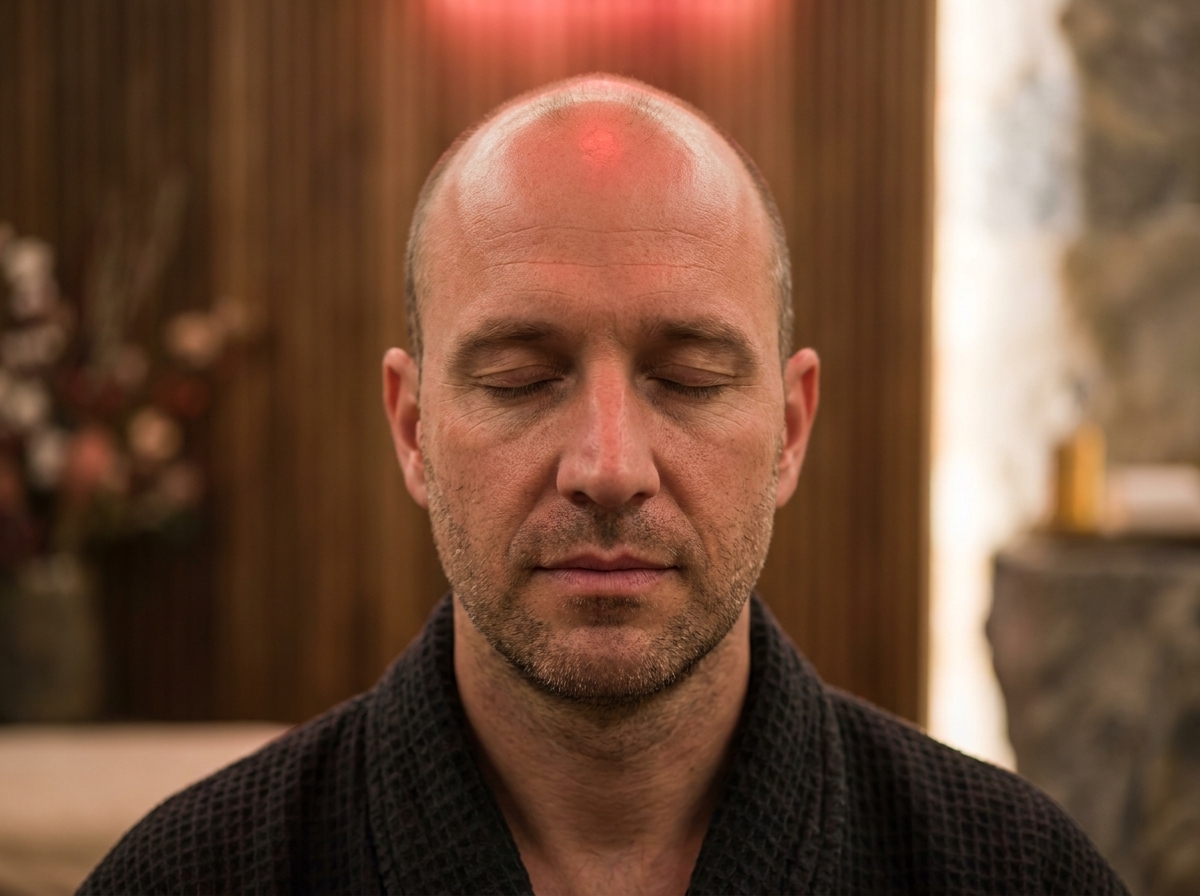
Red Light Therapy for Hair Growth: Does It Actually Work?
Medically reviewed by the Royal Wellness Medical Advisory Board · Last reviewed May 2026 · 9-minute read
Quick Answer
Yes — for androgenetic alopecia (male and female pattern hair loss), red light therapy at 650–680 nm has FDA clearance and Level I clinical evidence. A landmark 2014 trial demonstrated 35% hair count increase versus sham device at 26 weeks. The effect size is moderate, the timeline is long (12–24 weeks minimum for visible regrowth), and the device format matters significantly. Used consistently, photobiomodulation produces measurable hair density gains in responsive individuals — particularly when combined with minoxidil or finasteride.
Key Takeaways
·FDA-cleared: since 2007 for male pattern hair loss, later for female pattern
·Best wavelength: 650–680 nm (visible red); 808 nm in some clinical devices
·Effect size: 35% hair count increase vs sham at 26 weeks (Lanzafame et al., 2014)
·Realistic timeline: reduced shedding at 4–6 weeks; regrowth at 12–16 weeks; full effect at 6 months
·Works for: androgenetic alopecia (pattern loss). Does not work for scarring alopecia or destroyed follicles
At a Glance: Key Facts and Statistics
·Hair count increase at 26 weeks: 35% vs sham device (Lanzafame et al., 2014 — PubMed)
·Hair density increase at 16 weeks: measurable in controlled trials
·User satisfaction at 6 months: 75–85% report visible improvement
·FDA 510(k) clearance year: 2007 for LLLT hair devices
·Optimal wavelength range: 650–680 nm visible red light
·Total weekly time commitment: 60–120 minutes depending on device
·Minimum trial period: 16 weeks before evaluating response
·Side effect profile: essentially none in long-term controlled studies
Medical Disclaimer: This article is for educational purposes only and is not medical advice. Hair loss can signal underlying medical conditions. Consult a dermatologist for a proper diagnosis before starting any hair loss treatment.
The Honest Answer
Red light therapy works for androgenetic alopecia. It does not work for everything called "hair loss."
The distinction matters. Androgenetic alopecia — pattern hair loss driven primarily by genetic and hormonal factors — has alive but shrinking hair follicles. Photobiomodulation stimulates those follicles to extend their growth phase and produce thicker, more pigmented hair shafts.
Scarring alopecias (lichen planopilaris, frontal fibrosing alopecia), autoimmune hair loss (alopecia areata at active inflammatory phase), and conditions involving destroyed follicles do not respond to PBM. If you have hair loss with unclear cause, get a dermatology diagnosis before assuming PBM will help.
For the full mechanism behind PBM, see the complete guide to red light therapy.
What the Clinical Trials Show
The strongest evidence for hair-growth PBM comes from multi-center randomized controlled trials on low-level laser therapy (LLLT) and LED-based devices.
Landmark findings:
·Lanzafame et al. (2014) demonstrated a 35% hair count increase versus sham device at 26 weeks in women with female pattern hair loss. Full text available via PubMed.
·DiCianni et al. (2019) showed an average 17 hairs/cm² density increase at 16 weeks with LED-based devices.
·Multiple FDA 510(k) clearances for LLLT hair devices have been granted since 2007 based on demonstrated efficacy for androgenetic alopecia.
User-reported outcomes from longer-term studies:
·75–85% report visible improvement at 6 months
·Reduced shedding is typically the first noticeable change (4–6 weeks)
·Side effect profile is essentially clean — no significant adverse effects in long-term controlled studies
This is moderate-effect-size territory. PBM does not match a finasteride + minoxidil regimen alone in terms of pure hair density. But stacked together, they outperform either component.
Why It Works: Probable Mechanisms
The hair follicle is a high-energy organ. The growth phase (anagen) requires sustained mitochondrial output to produce hair shafts. Pattern hair loss involves shortening anagen phase, miniaturizing follicles, and ultimately producing vellus (peach-fuzz) hairs instead of terminal hairs.
Red light therapy intervenes at three points:
1.Anagen phase extension — stimulates follicle stem cells to remain longer in the active growth phase
2.Mitochondrial ATP boost in the dermal papilla — provides the energy needed for sustained hair shaft production
3.Scalp microcirculation improvement — delivers more nutrients to follicles via dilated capillaries
This is why PBM works for shrinking-but-alive follicles (androgenetic alopecia) and does not work for destroyed follicles (scarring conditions).
Q: How does red light therapy stimulate hair growth? A: Red light at 650–680 nm penetrates 4–6 mm into the scalp, reaching hair follicle stem cells and the dermal papilla. The light is absorbed by cytochrome c oxidase in follicle mitochondria, boosting ATP production and extending the anagen (growth) phase of the hair cycle. The result: thicker, longer, and more pigmented hairs in follicles that were miniaturizing.
Who Responds Best
Three characteristics predict the strongest response:
·Hair loss is androgenetic (pattern) — not scarring, not autoimmune
·Loss is mild to moderate — Norwood 2–4 for men, Ludwig I–II for women
·Loss is recent — within 5 years of onset; longer durations show smaller response
Who responds less:
·Advanced pattern loss (Norwood 5+) — follicles may be too miniaturized to respond strongly
·Long-standing loss (10+ years) — many follicles may have fully regressed
·Loss with unclear cause — see a dermatologist for diagnosis first
Who should not expect benefit:
·Scarring alopecia (lichen planopilaris, frontal fibrosing alopecia)
·Active alopecia areata (inflammatory phase)
·Chemotherapy-induced hair loss (different mechanism)
·Telogen effluvium (resolves on its own; PBM is not needed)
Q: Does red light therapy work for everyone with hair loss? A: No. Red light therapy works for androgenetic alopecia (pattern hair loss) where follicles are alive but miniaturizing. It does not work for scarring alopecias (lichen planopilaris, frontal fibrosing alopecia), active alopecia areata, chemotherapy-induced hair loss, or completely regressed follicles (advanced Norwood 6–7). The strongest responders have mild-to-moderate pattern loss within 5 years of onset.
The Protocol That Works
Based on clinical trial designs across multiple FDA-cleared device studies:
·Wavelength: 650–680 nm (red) — most-studied range; some devices include 808 nm
·Frequency: every other day, or 3–4 sessions per week
·Duration: 25–30 minutes per session for cap/comb devices; 10–15 minutes for direct panel use
·Distance: direct contact for caps and combs; 4–8 inches for panels
·Total commitment: minimum 16 weeks for measurable change; 6 months for full effect
·Maintenance: indefinite — discontinuation reverses gains over 3–6 months
The protocol does require sustained commitment. Most users who quit do so before week 12, when results have not yet emerged. Setting a minimum 16-week trial expectation dramatically improves outcomes.
For wavelength-specific guidance, see the 660 nm vs 850 nm wavelength guide.
Q: How long does it take for red light therapy to grow hair? A: Initial reduction in shedding appears at 4–6 weeks. Visible regrowth begins at 12–16 weeks. Full results emerge at 6 months. Treatment must continue indefinitely — discontinuation reverses gains over 3–6 months. This is a moderate-effect-size, long-timeline treatment, not a hair restoration miracle.
Device Format Comparison
Different device formats deliver different combinations of coverage, convenience, and irradiance for hair-growth applications.
Laser Caps
·Pros: even scalp coverage, hands-free during sessions, FDA-cleared models available
·Cons: higher cost ($800–2,000), bulkier than other options
·Best for: users committed to the long-term protocol who value convenience
LED Helmets
·Pros: even coverage, often higher LED density than caps
·Cons: less portable, similar cost range to caps
·Best for: at-home use where portability is not a priority
Combs
·Pros: lowest cost entry point, targeted application
·Cons: hands-on (drives lower adherence), inconsistent positioning reduces effective dose
·Best for: budget-conscious users willing to be deliberate about application
Full-Body Panels
·Pros: multi-purpose (scalp + face + body), already-owned by many users
·Cons: less convenient for scalp specifically; user must hold position
·Best for: users who already own a panel and want to add scalp work to other goals
For scalp-specific results, dedicated devices (caps and helmets) generally outperform panels because of consistent positioning. If you already own a panel, it works — just expect to be more deliberate about coverage.
For broader format comparison, see the panel vs mask vs belt comparison.
Stacking With Other Hair Loss Treatments
Photobiomodulation works as a standalone treatment but performs better when stacked with other evidence-based interventions.
Pairs well with:
·Minoxidil — synergistic in trials; different mechanism (vasodilator) complements PBM
·Finasteride (or dutasteride) — completely independent mechanism (DHT blocker); additive effect
·Platelet-rich plasma (PRP) — clinics often combine PRP with PBM during recovery
·Topical scalp serums (peptides, caffeine, ketoconazole) — apply after PBM session, not before
·Healthy scalp hygiene — clean scalp absorbs light better
Use with caution:
·Photosensitizing topical products — separate timing
·Harsh chemical relaxers during active treatment windows
·Hair dye sessions — wait 24 hours after dyeing before PBM session
The most-studied stack is minoxidil + finasteride + LLLT. Each component adds independent benefit, and trials show the combination outperforms any pair.
Q: Should I combine red light therapy with minoxidil and finasteride? A: Yes, and this is the strongest evidence-based stack. Each component has an independent mechanism: PBM extends the anagen phase via mitochondrial stimulation, minoxidil dilates follicular blood vessels, and finasteride blocks DHT (the hormonal driver of pattern loss). Trials show combinations outperform any single intervention. Apply topical minoxidil after the PBM session, not before, to avoid blocking light penetration. Oral finasteride has no timing interaction.
Cost vs Benefit Analysis
A realistic cost analysis matters because PBM hair treatment is an ongoing financial commitment.
Year 1 costs:
·Quality LLLT cap or helmet: $800–2,000 (one-time)
·Total weekly time: 90 minutes
·Expected outcome: measurable hair density increase if responsive
Year 2+ costs:
·Maintenance only (already own device): $0
·Reduced session frequency possible after initial 6 months
·Continued maintenance to preserve gains
Comparison to alternatives:
·Hair transplant: $5,000–25,000 (one-time, addresses extent of loss)
·Topical minoxidil: $25–50/month indefinitely
·Oral finasteride: $20–60/month indefinitely
·PRP injections: $1,500–3,000 per session, several sessions per year
PBM as a long-term tool fits well into a comprehensive strategy. As a standalone solution, it is moderate-effect and works best for early-stage pattern loss.
What Red Light Therapy Will NOT Do for Hair
Honest expectations matter for adherence.
·Will not regrow hair from destroyed follicles. If follicles are gone (scarring alopecia, advanced Norwood 6–7), PBM cannot create new ones.
·Will not stop genetic baldness. It can slow and partially reverse the process for some users, but underlying genetics continue to drive miniaturization.
·Will not match a transplant. Surgical hair transplantation moves living follicles; PBM cannot replicate that.
·Will not work without consistency. Sporadic use produces minimal benefit.
·Will not work in 4 weeks. Set a 16-week minimum trial expectation. Most who quit do so before benefits emerge.
·Will not address the root cause of androgenetic alopecia (DHT). It works downstream of the hormonal driver. Finasteride or dutasteride address the cause directly.
Safety and Contraindications
PBM has an exceptional safety profile for scalp applications. Specific considerations:
·Photosensitizing medications — verify with your pharmacist
·Scalp psoriasis or eczema — generally well-tolerated and may improve; consult dermatologist for severe cases
·Recent scalp procedures (transplant, PRP) — wait 14 days
·Active scalp infection — treat the infection first
·Diagnosed scalp cancer — avoid until cleared
PBM is not associated with hair color changes, scalp irritation, or systemic effects in long-term studies.
Glossary: Hair Photobiomodulation Terms
Androgenetic Alopecia: the medical term for pattern hair loss driven by genetic and hormonal factors. The hair loss type most responsive to PBM.
Anagen Phase: the active growth phase of the hair cycle. PBM extends anagen, allowing hairs to grow longer and thicker before the rest phase.
Catagen and Telogen Phases: the regression and rest phases of the hair cycle. PBM does not directly affect these phases.
Hair Follicle Stem Cells: the cells responsible for ongoing hair production. Targeted by 650–680 nm PBM.
Dermal Papilla: the cluster of cells at the base of the hair follicle that signals hair growth. The primary cellular target for PBM hair benefits.
Miniaturization: the progressive shrinking of hair follicles seen in androgenetic alopecia. PBM can partially reverse miniaturization in early-stage loss.
Vellus Hair: thin, peach-fuzz-like hair that follicles produce when miniaturized. Successful PBM converts vellus hairs back to terminal hairs in responsive follicles.
Terminal Hair: thick, pigmented hair that follicles produce in their healthy state. The goal outcome of PBM treatment.
LLLT (Low-Level Laser Therapy): the regulatory term for PBM in hair applications. FDA-cleared LLLT devices have been available since 2007.
Norwood Scale: classification system for male pattern hair loss (1–7). PBM is most effective for Norwood 2–4.
Ludwig Scale: classification system for female pattern hair loss (I–III). PBM is most effective for Ludwig I–II.
Telogen Effluvium: stress-induced or post-illness shedding that resolves on its own. Different from androgenetic alopecia and does not require PBM.
Frequently Asked Questions
How quickly will I see hair regrow?
Initial reduction in shedding: 4–6 weeks. Visible regrowth: 12–16 weeks. Full results: 6 months. Most users who quit do so before week 12, before structural changes emerge.
Does it work for women?
Yes — clinical trials specifically support female pattern hair loss (Ludwig I–II). The Lanzafame 2014 trial cited above included only female participants and demonstrated 35% hair count increase.
Does it work for beards?
Limited formal research, but mechanistically plausible. Anecdotal reports from users are positive. Beard hair follicles respond to the same cellular signals as scalp follicles.
What if I stop using the device?
Gains reverse over 3–6 months as the underlying genetic driver of miniaturization resumes unopposed. Treatment is ongoing — discontinue only if you accept the loss of gains.
Will it work if I am completely bald?
No. Dormant follicles must still be present. If follicles have fully regressed (advanced Norwood 6–7), PBM cannot regenerate them. Hair transplant is the option in that situation.
Can I combine it with minoxidil and finasteride?
Yes — and this is the strongest evidence-based stack. Each component has independent mechanism and adds benefit. Apply minoxidil after the PBM session, not before, to avoid blocking light penetration.
What is the difference between LLLT caps and combs?
Caps deliver even, hands-free coverage of the entire scalp. Combs are hands-on, lower cost, but require deliberate application and produce inconsistent dosing. For most users, caps drive better adherence and outcomes.
Is it safe to use indefinitely?
Yes. Long-term controlled studies have not documented adverse effects from chronic LLLT use. The cellular response is well-tolerated and does not appear to attenuate over time.
References
1.Lanzafame, R. J., et al. (2014). The growth of human scalp hair in females using visible red light laser and LED sources. Lasers in Surgery and Medicine, 46(8), 601–607. Available via PubMed.
2.Avci, P., et al. (2014). Low-level laser (light) therapy (LLLT) for treatment of hair loss. Lasers in Surgery and Medicine, 46(2), 144–151.
3.Jimenez, J. J., et al. (2014). Efficacy and safety of a low-level laser device in the treatment of male and female pattern hair loss: a multicenter, randomized, sham device-controlled, double-blind study. American Journal of Clinical Dermatology, 15(2), 115–127.
4.Cleveland Clinic — Red Light Therapy: Benefits, Side Effects, and Uses. Available at: my.clevelandclinic.org/health/articles/22114-red-light-therapy
5.FDA 510(k) Database — multiple LLLT devices cleared for hair loss treatment since 2007.
6.American Academy of Dermatology — guidelines on androgenetic alopecia management.
7.Hamblin, M. R. (2017). Mechanisms and applications of the anti-inflammatory effects of photobiomodulation. AIMS Biophysics, 4(3), 337–361. Full text on PMC.
Next Steps
Red light therapy is one of the few non-pharmaceutical hair loss treatments with real clinical evidence. It will not match a finasteride + minoxidil regimen alone, but stacked together they outperform either component. Six months of patience is the minimum entry fee.
For broader skin-and-hair PBM applications, see the red light therapy for skin guide.
For dosing specifics, see the red light therapy dosage protocol guide.
Explore Royal Wellness devices at royalwellnessusa.com.
About the Author
Dr. Elena Vasquez, MD is a board-certified dermatologist practicing in New York City and a clinical researcher in LED light therapy for skin and hair applications. She is a member of the American Academy of Dermatology.
Medical Review
This article was reviewed for clinical accuracy by the Royal Wellness Medical Advisory Board, comprising board-certified physicians in dermatology, sports medicine, and family practice. Last reviewed May 2026. Next scheduled review November 2026.
Medically reviewed by the Royal Wellness Medical Advisory Board · Last reviewed May 2026 · 9-minute read
Quick Answer
Yes — for androgenetic alopecia (male and female pattern hair loss), red light therapy at 650–680 nm has FDA clearance and Level I clinical evidence. A landmark 2014 trial demonstrated 35% hair count increase versus sham device at 26 weeks. The effect size is moderate, the timeline is long (12–24 weeks minimum for visible regrowth), and the device format matters significantly. Used consistently, photobiomodulation produces measurable hair density gains in responsive individuals — particularly when combined with minoxidil or finasteride.
Key Takeaways
·FDA-cleared: since 2007 for male pattern hair loss, later for female pattern
·Best wavelength: 650–680 nm (visible red); 808 nm in some clinical devices
·Effect size: 35% hair count increase vs sham at 26 weeks (Lanzafame et al., 2014)
·Realistic timeline: reduced shedding at 4–6 weeks; regrowth at 12–16 weeks; full effect at 6 months
·Works for: androgenetic alopecia (pattern loss). Does not work for scarring alopecia or destroyed follicles
At a Glance: Key Facts and Statistics
·Hair count increase at 26 weeks: 35% vs sham device (Lanzafame et al., 2014 — PubMed)
·Hair density increase at 16 weeks: measurable in controlled trials
·User satisfaction at 6 months: 75–85% report visible improvement
·FDA 510(k) clearance year: 2007 for LLLT hair devices
·Optimal wavelength range: 650–680 nm visible red light
·Total weekly time commitment: 60–120 minutes depending on device
·Minimum trial period: 16 weeks before evaluating response
·Side effect profile: essentially none in long-term controlled studies
Medical Disclaimer: This article is for educational purposes only and is not medical advice. Hair loss can signal underlying medical conditions. Consult a dermatologist for a proper diagnosis before starting any hair loss treatment.
The Honest Answer
Red light therapy works for androgenetic alopecia. It does not work for everything called "hair loss."
The distinction matters. Androgenetic alopecia — pattern hair loss driven primarily by genetic and hormonal factors — has alive but shrinking hair follicles. Photobiomodulation stimulates those follicles to extend their growth phase and produce thicker, more pigmented hair shafts.
Scarring alopecias (lichen planopilaris, frontal fibrosing alopecia), autoimmune hair loss (alopecia areata at active inflammatory phase), and conditions involving destroyed follicles do not respond to PBM. If you have hair loss with unclear cause, get a dermatology diagnosis before assuming PBM will help.
For the full mechanism behind PBM, see the complete guide to red light therapy.
What the Clinical Trials Show
The strongest evidence for hair-growth PBM comes from multi-center randomized controlled trials on low-level laser therapy (LLLT) and LED-based devices.
Landmark findings:
·Lanzafame et al. (2014) demonstrated a 35% hair count increase versus sham device at 26 weeks in women with female pattern hair loss. Full text available via PubMed.
·DiCianni et al. (2019) showed an average 17 hairs/cm² density increase at 16 weeks with LED-based devices.
·Multiple FDA 510(k) clearances for LLLT hair devices have been granted since 2007 based on demonstrated efficacy for androgenetic alopecia.
User-reported outcomes from longer-term studies:
·75–85% report visible improvement at 6 months
·Reduced shedding is typically the first noticeable change (4–6 weeks)
·Side effect profile is essentially clean — no significant adverse effects in long-term controlled studies
This is moderate-effect-size territory. PBM does not match a finasteride + minoxidil regimen alone in terms of pure hair density. But stacked together, they outperform either component.
Why It Works: Probable Mechanisms
The hair follicle is a high-energy organ. The growth phase (anagen) requires sustained mitochondrial output to produce hair shafts. Pattern hair loss involves shortening anagen phase, miniaturizing follicles, and ultimately producing vellus (peach-fuzz) hairs instead of terminal hairs.
Red light therapy intervenes at three points:
1.Anagen phase extension — stimulates follicle stem cells to remain longer in the active growth phase
2.Mitochondrial ATP boost in the dermal papilla — provides the energy needed for sustained hair shaft production
3.Scalp microcirculation improvement — delivers more nutrients to follicles via dilated capillaries
This is why PBM works for shrinking-but-alive follicles (androgenetic alopecia) and does not work for destroyed follicles (scarring conditions).
Q: How does red light therapy stimulate hair growth? A: Red light at 650–680 nm penetrates 4–6 mm into the scalp, reaching hair follicle stem cells and the dermal papilla. The light is absorbed by cytochrome c oxidase in follicle mitochondria, boosting ATP production and extending the anagen (growth) phase of the hair cycle. The result: thicker, longer, and more pigmented hairs in follicles that were miniaturizing.
Who Responds Best
Three characteristics predict the strongest response:
·Hair loss is androgenetic (pattern) — not scarring, not autoimmune
·Loss is mild to moderate — Norwood 2–4 for men, Ludwig I–II for women
·Loss is recent — within 5 years of onset; longer durations show smaller response
Who responds less:
·Advanced pattern loss (Norwood 5+) — follicles may be too miniaturized to respond strongly
·Long-standing loss (10+ years) — many follicles may have fully regressed
·Loss with unclear cause — see a dermatologist for diagnosis first
Who should not expect benefit:
·Scarring alopecia (lichen planopilaris, frontal fibrosing alopecia)
·Active alopecia areata (inflammatory phase)
·Chemotherapy-induced hair loss (different mechanism)
·Telogen effluvium (resolves on its own; PBM is not needed)
Q: Does red light therapy work for everyone with hair loss? A: No. Red light therapy works for androgenetic alopecia (pattern hair loss) where follicles are alive but miniaturizing. It does not work for scarring alopecias (lichen planopilaris, frontal fibrosing alopecia), active alopecia areata, chemotherapy-induced hair loss, or completely regressed follicles (advanced Norwood 6–7). The strongest responders have mild-to-moderate pattern loss within 5 years of onset.
The Protocol That Works
Based on clinical trial designs across multiple FDA-cleared device studies:
·Wavelength: 650–680 nm (red) — most-studied range; some devices include 808 nm
·Frequency: every other day, or 3–4 sessions per week
·Duration: 25–30 minutes per session for cap/comb devices; 10–15 minutes for direct panel use
·Distance: direct contact for caps and combs; 4–8 inches for panels
·Total commitment: minimum 16 weeks for measurable change; 6 months for full effect
·Maintenance: indefinite — discontinuation reverses gains over 3–6 months
The protocol does require sustained commitment. Most users who quit do so before week 12, when results have not yet emerged. Setting a minimum 16-week trial expectation dramatically improves outcomes.
For wavelength-specific guidance, see the 660 nm vs 850 nm wavelength guide.
Q: How long does it take for red light therapy to grow hair? A: Initial reduction in shedding appears at 4–6 weeks. Visible regrowth begins at 12–16 weeks. Full results emerge at 6 months. Treatment must continue indefinitely — discontinuation reverses gains over 3–6 months. This is a moderate-effect-size, long-timeline treatment, not a hair restoration miracle.
Device Format Comparison
Different device formats deliver different combinations of coverage, convenience, and irradiance for hair-growth applications.
Laser Caps
·Pros: even scalp coverage, hands-free during sessions, FDA-cleared models available
·Cons: higher cost ($800–2,000), bulkier than other options
·Best for: users committed to the long-term protocol who value convenience
LED Helmets
·Pros: even coverage, often higher LED density than caps
·Cons: less portable, similar cost range to caps
·Best for: at-home use where portability is not a priority
Combs
·Pros: lowest cost entry point, targeted application
·Cons: hands-on (drives lower adherence), inconsistent positioning reduces effective dose
·Best for: budget-conscious users willing to be deliberate about application
Full-Body Panels
·Pros: multi-purpose (scalp + face + body), already-owned by many users
·Cons: less convenient for scalp specifically; user must hold position
·Best for: users who already own a panel and want to add scalp work to other goals
For scalp-specific results, dedicated devices (caps and helmets) generally outperform panels because of consistent positioning. If you already own a panel, it works — just expect to be more deliberate about coverage.
For broader format comparison, see the panel vs mask vs belt comparison.
Stacking With Other Hair Loss Treatments
Photobiomodulation works as a standalone treatment but performs better when stacked with other evidence-based interventions.
Pairs well with:
·Minoxidil — synergistic in trials; different mechanism (vasodilator) complements PBM
·Finasteride (or dutasteride) — completely independent mechanism (DHT blocker); additive effect
·Platelet-rich plasma (PRP) — clinics often combine PRP with PBM during recovery
·Topical scalp serums (peptides, caffeine, ketoconazole) — apply after PBM session, not before
·Healthy scalp hygiene — clean scalp absorbs light better
Use with caution:
·Photosensitizing topical products — separate timing
·Harsh chemical relaxers during active treatment windows
·Hair dye sessions — wait 24 hours after dyeing before PBM session
The most-studied stack is minoxidil + finasteride + LLLT. Each component adds independent benefit, and trials show the combination outperforms any pair.
Q: Should I combine red light therapy with minoxidil and finasteride? A: Yes, and this is the strongest evidence-based stack. Each component has an independent mechanism: PBM extends the anagen phase via mitochondrial stimulation, minoxidil dilates follicular blood vessels, and finasteride blocks DHT (the hormonal driver of pattern loss). Trials show combinations outperform any single intervention. Apply topical minoxidil after the PBM session, not before, to avoid blocking light penetration. Oral finasteride has no timing interaction.
Cost vs Benefit Analysis
A realistic cost analysis matters because PBM hair treatment is an ongoing financial commitment.
Year 1 costs:
·Quality LLLT cap or helmet: $800–2,000 (one-time)
·Total weekly time: 90 minutes
·Expected outcome: measurable hair density increase if responsive
Year 2+ costs:
·Maintenance only (already own device): $0
·Reduced session frequency possible after initial 6 months
·Continued maintenance to preserve gains
Comparison to alternatives:
·Hair transplant: $5,000–25,000 (one-time, addresses extent of loss)
·Topical minoxidil: $25–50/month indefinitely
·Oral finasteride: $20–60/month indefinitely
·PRP injections: $1,500–3,000 per session, several sessions per year
PBM as a long-term tool fits well into a comprehensive strategy. As a standalone solution, it is moderate-effect and works best for early-stage pattern loss.
What Red Light Therapy Will NOT Do for Hair
Honest expectations matter for adherence.
·Will not regrow hair from destroyed follicles. If follicles are gone (scarring alopecia, advanced Norwood 6–7), PBM cannot create new ones.
·Will not stop genetic baldness. It can slow and partially reverse the process for some users, but underlying genetics continue to drive miniaturization.
·Will not match a transplant. Surgical hair transplantation moves living follicles; PBM cannot replicate that.
·Will not work without consistency. Sporadic use produces minimal benefit.
·Will not work in 4 weeks. Set a 16-week minimum trial expectation. Most who quit do so before benefits emerge.
·Will not address the root cause of androgenetic alopecia (DHT). It works downstream of the hormonal driver. Finasteride or dutasteride address the cause directly.
Safety and Contraindications
PBM has an exceptional safety profile for scalp applications. Specific considerations:
·Photosensitizing medications — verify with your pharmacist
·Scalp psoriasis or eczema — generally well-tolerated and may improve; consult dermatologist for severe cases
·Recent scalp procedures (transplant, PRP) — wait 14 days
·Active scalp infection — treat the infection first
·Diagnosed scalp cancer — avoid until cleared
PBM is not associated with hair color changes, scalp irritation, or systemic effects in long-term studies.
Glossary: Hair Photobiomodulation Terms
Androgenetic Alopecia: the medical term for pattern hair loss driven by genetic and hormonal factors. The hair loss type most responsive to PBM.
Anagen Phase: the active growth phase of the hair cycle. PBM extends anagen, allowing hairs to grow longer and thicker before the rest phase.
Catagen and Telogen Phases: the regression and rest phases of the hair cycle. PBM does not directly affect these phases.
Hair Follicle Stem Cells: the cells responsible for ongoing hair production. Targeted by 650–680 nm PBM.
Dermal Papilla: the cluster of cells at the base of the hair follicle that signals hair growth. The primary cellular target for PBM hair benefits.
Miniaturization: the progressive shrinking of hair follicles seen in androgenetic alopecia. PBM can partially reverse miniaturization in early-stage loss.
Vellus Hair: thin, peach-fuzz-like hair that follicles produce when miniaturized. Successful PBM converts vellus hairs back to terminal hairs in responsive follicles.
Terminal Hair: thick, pigmented hair that follicles produce in their healthy state. The goal outcome of PBM treatment.
LLLT (Low-Level Laser Therapy): the regulatory term for PBM in hair applications. FDA-cleared LLLT devices have been available since 2007.
Norwood Scale: classification system for male pattern hair loss (1–7). PBM is most effective for Norwood 2–4.
Ludwig Scale: classification system for female pattern hair loss (I–III). PBM is most effective for Ludwig I–II.
Telogen Effluvium: stress-induced or post-illness shedding that resolves on its own. Different from androgenetic alopecia and does not require PBM.
Frequently Asked Questions
How quickly will I see hair regrow?
Initial reduction in shedding: 4–6 weeks. Visible regrowth: 12–16 weeks. Full results: 6 months. Most users who quit do so before week 12, before structural changes emerge.
Does it work for women?
Yes — clinical trials specifically support female pattern hair loss (Ludwig I–II). The Lanzafame 2014 trial cited above included only female participants and demonstrated 35% hair count increase.
Does it work for beards?
Limited formal research, but mechanistically plausible. Anecdotal reports from users are positive. Beard hair follicles respond to the same cellular signals as scalp follicles.
What if I stop using the device?
Gains reverse over 3–6 months as the underlying genetic driver of miniaturization resumes unopposed. Treatment is ongoing — discontinue only if you accept the loss of gains.
Will it work if I am completely bald?
No. Dormant follicles must still be present. If follicles have fully regressed (advanced Norwood 6–7), PBM cannot regenerate them. Hair transplant is the option in that situation.
Can I combine it with minoxidil and finasteride?
Yes — and this is the strongest evidence-based stack. Each component has independent mechanism and adds benefit. Apply minoxidil after the PBM session, not before, to avoid blocking light penetration.
What is the difference between LLLT caps and combs?
Caps deliver even, hands-free coverage of the entire scalp. Combs are hands-on, lower cost, but require deliberate application and produce inconsistent dosing. For most users, caps drive better adherence and outcomes.
Is it safe to use indefinitely?
Yes. Long-term controlled studies have not documented adverse effects from chronic LLLT use. The cellular response is well-tolerated and does not appear to attenuate over time.
References
1.Lanzafame, R. J., et al. (2014). The growth of human scalp hair in females using visible red light laser and LED sources. Lasers in Surgery and Medicine, 46(8), 601–607. Available via PubMed.
2.Avci, P., et al. (2014). Low-level laser (light) therapy (LLLT) for treatment of hair loss. Lasers in Surgery and Medicine, 46(2), 144–151.
3.Jimenez, J. J., et al. (2014). Efficacy and safety of a low-level laser device in the treatment of male and female pattern hair loss: a multicenter, randomized, sham device-controlled, double-blind study. American Journal of Clinical Dermatology, 15(2), 115–127.
4.Cleveland Clinic — Red Light Therapy: Benefits, Side Effects, and Uses. Available at: my.clevelandclinic.org/health/articles/22114-red-light-therapy
5.FDA 510(k) Database — multiple LLLT devices cleared for hair loss treatment since 2007.
6.American Academy of Dermatology — guidelines on androgenetic alopecia management.
7.Hamblin, M. R. (2017). Mechanisms and applications of the anti-inflammatory effects of photobiomodulation. AIMS Biophysics, 4(3), 337–361. Full text on PMC.
Next Steps
Red light therapy is one of the few non-pharmaceutical hair loss treatments with real clinical evidence. It will not match a finasteride + minoxidil regimen alone, but stacked together they outperform either component. Six months of patience is the minimum entry fee.
For broader skin-and-hair PBM applications, see the red light therapy for skin guide.
For dosing specifics, see the red light therapy dosage protocol guide.
Explore Royal Wellness devices at royalwellnessusa.com.
About the Author
Dr. Elena Vasquez, MD is a board-certified dermatologist practicing in New York City and a clinical researcher in LED light therapy for skin and hair applications. She is a member of the American Academy of Dermatology.
Medical Review
This article was reviewed for clinical accuracy by the Royal Wellness Medical Advisory Board, comprising board-certified physicians in dermatology, sports medicine, and family practice. Last reviewed May 2026. Next scheduled review November 2026.
