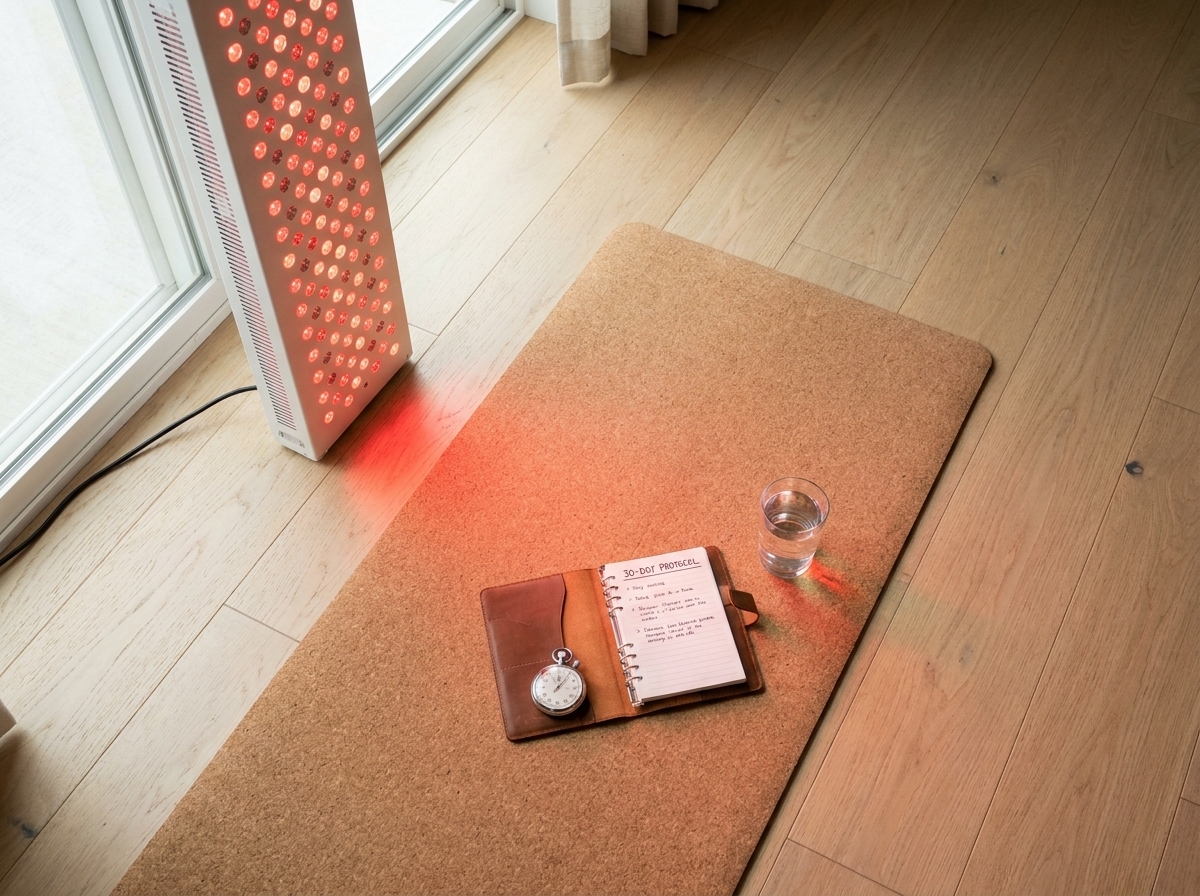
Red Light Therapy at Home: A 30-Day Beginner Protocol
Medically reviewed by the Royal Wellness Medical Advisory Board · Last reviewed May 2026 · 10-minute read
Quick Answer
The first 30 days of red light therapy build the foundation: progressive dose escalation, consistent timing, and baseline tracking. A three-phase protocol works for most beginners — conditioning (days 1–7) introduces tissue to the new oxidative signaling, building phase (days 8–14) increases dose, therapeutic phase (days 15–21) hits target dose, optimization phase (days 22–30) settles into a sustainable routine. By day 30, you have measurable baseline data, calibrated session parameters, and a sustainable habit pattern.
Key Takeaways
·Phase 1 (Days 1–7) — Conditioning: every other day, 5 minutes per area, 12 inches distance
·Phase 2 (Days 8–14) — Building: 4 sessions per week, 8 minutes per area, 8 inches distance
·Phase 3 (Days 15–21) — Therapeutic: 5 sessions per week, 10–15 minutes per area, 6–8 inches
·Phase 4 (Days 22–30) — Optimization: 5 sessions per week, 15 minutes per area, fine-tune based on response
·By day 30: baseline data established, consistent routine, initial subjective changes visible
At a Glance: Key Facts and Statistics
·Recommended starting frequency: every other day for first week
·Recommended starting duration: 5 minutes per body area
·Recommended starting distance: 12 inches (slightly further than therapeutic distance)
·Day 30 target frequency: 5 sessions per week
·Day 30 target duration: 10–15 minutes per area
·Day 30 target distance: 6 inches (or contact for belts)
·Subjective changes typically observed: by week 2
·Time to calibrated routine: 4 weeks of consistent practice
Medical Disclaimer: This article is for educational purposes only and is not medical advice. If you have a medical condition or are taking medications, consult your physician before starting any new wellness protocol.
The Goal of the First 30 Days
The first 30 days of red light therapy are not about peak results. They are about building consistency, calibrating your dose, and observing how your body responds.
By day 30, you should have:
·A daily schedule that you actually keep
·A confirmed device position and distance that produces the dose you want
·Initial subjective changes (skin glow, faster recovery, calmer evenings)
·Baseline data for measuring future improvements over months 2 and 3
This protocol works for anyone using a panel-style device (or equivalent). Adapt the body-area focus to your specific goal — skin, recovery, joints, brain, hair, or general wellness.
For the foundational biology, see the complete guide to red light therapy.
Before You Start: 3 Setup Steps
1. Confirm Device Specifications
Check your panel's irradiance at 6 inches. Most premium devices deliver 100–160 mW/cm². If your device's published spec is below 70 mW/cm² at 6 inches, plan for longer sessions or upgrade considerations.
For device evaluation, see the best red light therapy panel buyer's guide.
2. Pick Your Primary Goal
Define one primary goal for the first 30 days. Possibilities:
·Skin rejuvenation and anti-aging
·Muscle recovery (athletic or general)
·Joint or back pain
·Hair growth
·Brain photobiomodulation
·Sleep quality
·General wellness
Multi-goal protocols are reasonable after the first month. For the first 30 days, focus produces clearer feedback on what works.
3. Establish a Baseline
Take measurements relevant to your goal:
·Skin goal: dated photos in consistent light, same angle
·Recovery goal: soreness diary (1–10 scale), post-workout
·Pain goal: morning pain score (1–10), weekly
·Sleep goal: sleep tracker baseline week
·General wellness: energy 1–10 scale, evening
·Brain goal: cognitive baseline (memory app, simple tests)
These become your "before" picture for comparing later.
For dosage specifics by goal, see the red light therapy dosage protocol guide.
Phase 1 — Conditioning (Days 1–7)
The goal of Phase 1 is to introduce your tissue to the new oxidative signaling without overdoing it. The biphasic dose response means starting at full therapeutic dose can sometimes blunt response.
Days 1–7 protocol:
·Frequency: every other day (4 sessions in 7 days)
·Duration: 5 minutes per body area
·Distance: 12 inches (slightly further than therapeutic distance)
·Body areas: focus on your primary goal area only
·Time of day: pick morning or evening and stick with it
What to track:
·Any side effects (warmth, headache, fatigue) — should be none
·Subjective response (energy, sleep quality)
·Compliance with the schedule
If you experience any negative effects, extend the conditioning phase by another week before progressing. If everything is well-tolerated, proceed to Phase 2 on day 8.
Phase 2 — Building Phase (Days 8–14)
In Phase 2, you increase dose progressively as your tissue adapts.
Days 8–14 protocol:
·Frequency: 4 sessions per week (every other day plus one)
·Duration: 8 minutes per body area
·Distance: 8 inches
·Body areas: primary goal area plus one secondary area
·What to track: subjective changes (sleep quality, energy, skin feel, pain level)
By the end of week 2, you should notice subtle changes — often improved sleep onset or skin texture before anything else. If you see nothing yet, this is normal — structural changes are 4+ weeks away.
Q: How quickly will I see results from red light therapy in the first 30 days? A: Most users notice subtle subjective changes by week 2 — improved sleep onset, post-session glow, slightly better recovery from workouts. Measurable structural changes (skin texture, joint mobility, hair density) typically emerge between weeks 4 and 12, depending on the goal. The first 30 days are primarily about establishing the routine and observing initial response, not seeing dramatic transformation.
Phase 3 — Therapeutic Phase (Days 15–21)
In Phase 3, hit the target dose for your primary goal.
Days 15–21 protocol:
·Frequency: 5 sessions per week
·Duration: 10–15 minutes per body area
·Distance: 6–8 inches
·Body areas: primary plus secondary, in the same session
·What to track: measurable markers — pain scores, sleep tracker data, weekly skin photos
This is where most users start seeing real change. If you do not, audit your protocol against the 7 common mistakes.
Phase 4 — Optimization (Days 22–30)
In Phase 4, fine-tune based on your individual response.
Days 22–30 protocol:
·Frequency: 5 sessions per week
·Duration: 15 minutes per body area (extend to 20 if you have time)
·Distance: 6 inches
·Body areas: full body if device supports it
·What to track: comparison to baseline measurements
By day 30, you should have meaningful subjective and objective change — and a routine that fits your life.
Q: How do I start red light therapy at home? A: Use a three-phase progressive protocol over the first 30 days. Phase 1 (Days 1–7, Conditioning): every other day, 5 minutes per area at 12 inches. Phase 2 (Days 8–14, Building): 4 sessions per week, 8 minutes per area at 8 inches. Phase 3 (Days 15–21, Therapeutic): 5 sessions per week, 10–15 minutes per area at 6–8 inches. Phase 4 (Days 22–30, Optimization): 5 sessions per week, 15 minutes per area at 6 inches. Pick one primary goal for the first 30 days, take baseline measurements, and track 2–3 metrics relevant to that goal.
Daily Session Structure (Recommended)
The 15-minute therapeutic session, structured for efficiency:
·Minutes 0–2: preparation — clean skin (no sunscreen or lotions), position panel, set timer
·Minutes 2–7: front-body coverage — stand or sit facing the panel
·Minutes 7–12: back-body coverage — rotate
·Minutes 12–15: targeted areas — knees, shoulders, face, specific problem zones
Keep eyes closed when light is at eye level. Most panels include eye protection for extended sessions or include opaque goggles.
When to Use Your Sessions
The two most successful timing patterns:
Morning Sessions
·Within 30 minutes of waking
·Supports circadian alignment and morning energy
·Best for skin goals, general wellness, athletes with morning training
·Pairs naturally with morning skincare routine
Evening Sessions
·1–2 hours before bed
·Supports sleep quality and post-workout recovery
·Best for users training in late afternoon or with sleep goals
·Avoid within 30 minutes of intended bedtime
Pick one and stay consistent through the 30 days. Switching back and forth confuses circadian signaling and reduces measurable adherence.
For sleep-specific timing, see the red light therapy and sleep guide.
Q: What time of day is best for red light therapy? A: Both morning and evening work. Morning sessions (within 30 minutes of waking) support circadian alignment and morning energy — best for skin goals, athletes training in the morning, and users with low evening energy. Evening sessions (1–2 hours before bed) support sleep quality and post-workout recovery — best for users training in the afternoon and those with sleep goals. Pick one and stay consistent for the full 30-day protocol. Switching back and forth confuses circadian signaling and dilutes results.
What to Track
Simple tracking that catches change without overwhelming you:
Skin goal:
·Weekly photos in same light, same angle, no makeup
·Document subjective changes (texture, glow, firmness)
Recovery goal:
·Subjective soreness (1–10) post-workout, 48 hours after
·Days post-workout to feel "back to normal"
·Performance metrics if you train (reps to failure, sprint times)
Sleep goal:
·Sleep tracker data (deep sleep %, total sleep, sleep onset)
·Subjective morning energy (1–10)
·Time-to-feeling-fully-awake on waking
Pain goal:
·Morning pain score (1–10) at affected joint
·Mobility test (range of motion if feasible)
·Pain medication usage
General wellness:
·Energy level (1–10) each evening
·Mood score (1–10)
·Subjective sense of recovery
A simple notes app works fine. Resist the urge to track too many variables — over-tracking creates noise that obscures signal.
Q: What should I track during my first 30 days of red light therapy? A: Track the metric most directly tied to your primary goal. For skin: weekly photos in consistent light. For recovery: subjective soreness 1–10 plus performance metrics. For sleep: tracker data plus subjective quality. For pain: daily pain score 1–10. For brain: simple memory or cognitive tests. Resist tracking too many variables — focus on 2–3 metrics that map to your primary goal.
Day 30 Checkpoint
At day 30, review:
1.Did I hit 4–5 sessions per week consistently?
2.Did I see any of the expected early signs?
3.Is my distance and duration actually correct? (re-measure if needed)
4.What goal am I optimizing for going forward?
If consistency was poor, repeat days 8–30 with a focus on adherence before evaluating effectiveness. The protocol only works as well as you actually use it.
If consistency was good but no measurable change emerged, audit the common mistakes — protocol issues are the most common cause of "did not see results."
What to Expect After Day 30
Once the foundation is in place:
·Months 2–3: structural changes (collagen, hair density, joint mobility) become visible
·Months 4–6: stabilized maintenance phase, full benefit of the protocol
·Month 6+: consider adjusting protocol — frequency, duration, or adding specialty devices for additional goals
This is a long-term tool. The first 30 days are the entry, not the destination.
Common First-Month Issues and Fixes
"I am not seeing any results."
Audit distance, duration, frequency. Most "no results" cases trace to one of these errors. See the 7 mistakes guide for the full audit.
"I am too tired/busy to be consistent."
Pair sessions with an existing habit (morning coffee, evening shower). Drop session length to maintain frequency rather than skipping entirely.
"My skin feels slightly red after sessions."
Mild post-session warmth and slight pinkness is normal. Reduce session length by 25% for a week if it persists hours after the session.
"I am unsure if I am doing it right."
Re-read the device manual, verify wavelength and irradiance, time the actual session with a stopwatch. Most users find they were doing one parameter wrong.
"I had a flare-up of my condition."
Sometimes happens in week 1–2 as cellular signaling normalizes. Reduce frequency to every-other-day for one week, then resume. If symptoms persist or worsen, pause and consult a physician.
Goal-Specific Adaptations of the 30-Day Protocol
For Skin Rejuvenation
·Device: face mask preferred for adherence; panel works
·Time of day: morning or evening
·Specific addition: apply hyaluronic acid before sessions; sunscreen during the day always
·Expected at day 30: post-session glow established; texture changes by week 4
·See: Red Light Therapy for Skin
For Muscle Recovery (Athlete)
·Device: full-body panel preferred
·Time of day: within 2 hours post-workout primarily; evening also valid
·Specific addition: apply within the 2-hour post-exercise window
·Expected at day 30: noticeable DOMS reduction; performance gains begin
·See: Muscle Recovery for Athletes
For Joint Pain
·Device: belt/wrap preferred for direct contact; panel at 4–8 inches works
·Time of day: morning before activity or evening for chronic pain
·Specific addition: combine with stretching/PT exercises post-session
·Expected at day 30: acute pain reduction emerging; mobility shifts at week 8
·See: Joint and Back Pain
For Hair Growth
·Device: LLLT cap, helmet, or directed panel
·Time of day: consistent (morning or evening)
·Specific addition: consider stacking with minoxidil and/or finasteride (apply after session)
·Expected at day 30: reduced shedding emerging; regrowth at week 12+
·See: Hair Growth
For Sleep
·Device: any (face mask works well)
·Time of day: 1–2 hours before intended bedtime
·Specific addition: dim ambient light, avoid screens within 60 minutes of bed
·Expected at day 30: sleep onset faster, deeper sleep
·See: Sleep and Circadian Protocol
For Brain Photobiomodulation
·Device: 810 nm transcranial helmet
·Time of day: morning or early afternoon (avoid evening for some users)
·Specific addition: combine with cognitive training or meditation during sessions
·Expected at day 30: subjective clarity changes; measurable cognitive changes at week 12
·See: Brain Photobiomodulation
Glossary
Conditioning Phase: The first 1–2 weeks of a new protocol, deliberately under-dosed to allow tissue adaptation before reaching therapeutic doses.
Building Phase: The second week of a new protocol, progressively increasing dose toward therapeutic range.
Therapeutic Phase: The phase at which target dose is reached and primary benefits emerge.
Optimization Phase: The phase of fine-tuning protocol based on individual response.
Baseline Measurement: Initial measurements taken before starting a protocol, used for comparison over time.
Subjective Marker: Self-reported indicator of response (energy, skin feel, sleep quality). Useful but less reliable than objective markers.
Objective Marker: Measurable indicator (sleep tracker data, photo comparison, performance test). More reliable for tracking progress.
Protocol Audit: A systematic review of distance, time, frequency, wavelength, and lifestyle factors when results stall.
Compliance / Adherence: The percentage of scheduled sessions actually completed. The strongest predictor of results.
Biphasic Dose Response: Pharmacological pattern where low/moderate doses produce a positive response but high doses reverse the effect. PBM follows this pattern — starting at full dose can blunt response.
Frequently Asked Questions
Can I skip the conditioning phase if I am healthy?
You can compress it to 3 days, but starting at full dose increases the small risk of biphasic over-response. The conditioning phase is short and worth following for most users.
What if I miss a few days?
No problem. Resume at the previous phase. Do not double up sessions to catch up — this can trigger the over-dose end of the biphasic curve.
Should I combine this with other wellness tools?
Yes — sleep optimization, hydration, and recovery work all amplify red light therapy. Avoid extreme overlap with same-time stacking. See the relevant goal-specific guide for stacking recommendations.
Can I do this with a face mask instead of a panel?
Yes — adapt the protocol to face-only goals. Sessions are shorter (10 minutes); frequency similar (5x/week). The phases still apply.
What if I want to address multiple goals?
After the first 30 days focused on a single primary goal, you can add secondary goals. A typical multi-goal session: 5 minutes face + 10 minutes body + 5 minutes joint = 20-minute total session covering 3 goals.
What if I am traveling during the 30 days?
If traveling for 2+ weeks, pause and resume at the previous phase. For shorter trips, skip those days and resume on return. A travel-friendly wand or compact device helps maintain habit during shorter trips.
How do I know if I am responding to PBM?
Track 2–3 metrics relevant to your goal. Look for changes in trend over weeks, not days. If after 8 weeks of consistent correct protocol you see no change in your tracked metrics, audit the protocol or consult a physician about whether other interventions are needed.
Can children or older adults use this protocol?
Adults under 18 should consult a pediatrician before starting. Healthy older adults can use the standard protocol; those with multiple comorbidities should consult their physician for individual guidance.
References
1.Cleveland Clinic — Red Light Therapy: Benefits, Side Effects, and Uses. Available at: my.clevelandclinic.org/health/articles/22114-red-light-therapy
2.Huang, Y. Y., et al. (2009). Biphasic dose response in low level light therapy. Dose-Response, 7(4), 358–383.
3.Hamblin, M. R. (2017). Mechanisms and applications of the anti-inflammatory effects of photobiomodulation. AIMS Biophysics, 4(3), 337–361. Full text on PMC.
4.Ferraresi, C., Huang, Y. Y., & Hamblin, M. R. (2016). Photobiomodulation in human muscle tissue. Journal of Biophotonics, 9(11–12), 1273–1299.
5.UCLA Health — 5 Health Benefits of Red Light Therapy. Available at: uclahealth.org
Next Steps
Thirty days will not transform you, but it will calibrate you. By day 30, you have a working protocol, measurable baseline data, and a routine that fits your life. From there, consistent execution over 3–6 months is what delivers the visible, lasting results red light therapy is known for.
For dosage specifics by goal, see the red light therapy dosage protocol guide.
For troubleshooting if results stall, see the 7 mistakes killing your results.
For the foundational science and broader context, see the complete guide to red light therapy.
Explore Royal Wellness devices engineered for daily home use at royalwellnessusa.com.
About the Author
Marcus Reid, CSCS is a Certified Strength and Conditioning Specialist (NSCA) and former CrossFit Regional athlete. He has trained over 200 pro and semi-pro athletes on recovery protocols and habit-building patterns.
Medical Review
This article was reviewed for clinical accuracy by the Royal Wellness Medical Advisory Board, comprising board-certified physicians in dermatology, sports medicine, and family practice. Last reviewed May 2026. Next scheduled review November 2026.
Medically reviewed by the Royal Wellness Medical Advisory Board · Last reviewed May 2026 · 10-minute read
Quick Answer
The first 30 days of red light therapy build the foundation: progressive dose escalation, consistent timing, and baseline tracking. A three-phase protocol works for most beginners — conditioning (days 1–7) introduces tissue to the new oxidative signaling, building phase (days 8–14) increases dose, therapeutic phase (days 15–21) hits target dose, optimization phase (days 22–30) settles into a sustainable routine. By day 30, you have measurable baseline data, calibrated session parameters, and a sustainable habit pattern.
Key Takeaways
·Phase 1 (Days 1–7) — Conditioning: every other day, 5 minutes per area, 12 inches distance
·Phase 2 (Days 8–14) — Building: 4 sessions per week, 8 minutes per area, 8 inches distance
·Phase 3 (Days 15–21) — Therapeutic: 5 sessions per week, 10–15 minutes per area, 6–8 inches
·Phase 4 (Days 22–30) — Optimization: 5 sessions per week, 15 minutes per area, fine-tune based on response
·By day 30: baseline data established, consistent routine, initial subjective changes visible
At a Glance: Key Facts and Statistics
·Recommended starting frequency: every other day for first week
·Recommended starting duration: 5 minutes per body area
·Recommended starting distance: 12 inches (slightly further than therapeutic distance)
·Day 30 target frequency: 5 sessions per week
·Day 30 target duration: 10–15 minutes per area
·Day 30 target distance: 6 inches (or contact for belts)
·Subjective changes typically observed: by week 2
·Time to calibrated routine: 4 weeks of consistent practice
Medical Disclaimer: This article is for educational purposes only and is not medical advice. If you have a medical condition or are taking medications, consult your physician before starting any new wellness protocol.
The Goal of the First 30 Days
The first 30 days of red light therapy are not about peak results. They are about building consistency, calibrating your dose, and observing how your body responds.
By day 30, you should have:
·A daily schedule that you actually keep
·A confirmed device position and distance that produces the dose you want
·Initial subjective changes (skin glow, faster recovery, calmer evenings)
·Baseline data for measuring future improvements over months 2 and 3
This protocol works for anyone using a panel-style device (or equivalent). Adapt the body-area focus to your specific goal — skin, recovery, joints, brain, hair, or general wellness.
For the foundational biology, see the complete guide to red light therapy.
Before You Start: 3 Setup Steps
1. Confirm Device Specifications
Check your panel's irradiance at 6 inches. Most premium devices deliver 100–160 mW/cm². If your device's published spec is below 70 mW/cm² at 6 inches, plan for longer sessions or upgrade considerations.
For device evaluation, see the best red light therapy panel buyer's guide.
2. Pick Your Primary Goal
Define one primary goal for the first 30 days. Possibilities:
·Skin rejuvenation and anti-aging
·Muscle recovery (athletic or general)
·Joint or back pain
·Hair growth
·Brain photobiomodulation
·Sleep quality
·General wellness
Multi-goal protocols are reasonable after the first month. For the first 30 days, focus produces clearer feedback on what works.
3. Establish a Baseline
Take measurements relevant to your goal:
·Skin goal: dated photos in consistent light, same angle
·Recovery goal: soreness diary (1–10 scale), post-workout
·Pain goal: morning pain score (1–10), weekly
·Sleep goal: sleep tracker baseline week
·General wellness: energy 1–10 scale, evening
·Brain goal: cognitive baseline (memory app, simple tests)
These become your "before" picture for comparing later.
For dosage specifics by goal, see the red light therapy dosage protocol guide.
Phase 1 — Conditioning (Days 1–7)
The goal of Phase 1 is to introduce your tissue to the new oxidative signaling without overdoing it. The biphasic dose response means starting at full therapeutic dose can sometimes blunt response.
Days 1–7 protocol:
·Frequency: every other day (4 sessions in 7 days)
·Duration: 5 minutes per body area
·Distance: 12 inches (slightly further than therapeutic distance)
·Body areas: focus on your primary goal area only
·Time of day: pick morning or evening and stick with it
What to track:
·Any side effects (warmth, headache, fatigue) — should be none
·Subjective response (energy, sleep quality)
·Compliance with the schedule
If you experience any negative effects, extend the conditioning phase by another week before progressing. If everything is well-tolerated, proceed to Phase 2 on day 8.
Phase 2 — Building Phase (Days 8–14)
In Phase 2, you increase dose progressively as your tissue adapts.
Days 8–14 protocol:
·Frequency: 4 sessions per week (every other day plus one)
·Duration: 8 minutes per body area
·Distance: 8 inches
·Body areas: primary goal area plus one secondary area
·What to track: subjective changes (sleep quality, energy, skin feel, pain level)
By the end of week 2, you should notice subtle changes — often improved sleep onset or skin texture before anything else. If you see nothing yet, this is normal — structural changes are 4+ weeks away.
Q: How quickly will I see results from red light therapy in the first 30 days? A: Most users notice subtle subjective changes by week 2 — improved sleep onset, post-session glow, slightly better recovery from workouts. Measurable structural changes (skin texture, joint mobility, hair density) typically emerge between weeks 4 and 12, depending on the goal. The first 30 days are primarily about establishing the routine and observing initial response, not seeing dramatic transformation.
Phase 3 — Therapeutic Phase (Days 15–21)
In Phase 3, hit the target dose for your primary goal.
Days 15–21 protocol:
·Frequency: 5 sessions per week
·Duration: 10–15 minutes per body area
·Distance: 6–8 inches
·Body areas: primary plus secondary, in the same session
·What to track: measurable markers — pain scores, sleep tracker data, weekly skin photos
This is where most users start seeing real change. If you do not, audit your protocol against the 7 common mistakes.
Phase 4 — Optimization (Days 22–30)
In Phase 4, fine-tune based on your individual response.
Days 22–30 protocol:
·Frequency: 5 sessions per week
·Duration: 15 minutes per body area (extend to 20 if you have time)
·Distance: 6 inches
·Body areas: full body if device supports it
·What to track: comparison to baseline measurements
By day 30, you should have meaningful subjective and objective change — and a routine that fits your life.
Q: How do I start red light therapy at home? A: Use a three-phase progressive protocol over the first 30 days. Phase 1 (Days 1–7, Conditioning): every other day, 5 minutes per area at 12 inches. Phase 2 (Days 8–14, Building): 4 sessions per week, 8 minutes per area at 8 inches. Phase 3 (Days 15–21, Therapeutic): 5 sessions per week, 10–15 minutes per area at 6–8 inches. Phase 4 (Days 22–30, Optimization): 5 sessions per week, 15 minutes per area at 6 inches. Pick one primary goal for the first 30 days, take baseline measurements, and track 2–3 metrics relevant to that goal.
Daily Session Structure (Recommended)
The 15-minute therapeutic session, structured for efficiency:
·Minutes 0–2: preparation — clean skin (no sunscreen or lotions), position panel, set timer
·Minutes 2–7: front-body coverage — stand or sit facing the panel
·Minutes 7–12: back-body coverage — rotate
·Minutes 12–15: targeted areas — knees, shoulders, face, specific problem zones
Keep eyes closed when light is at eye level. Most panels include eye protection for extended sessions or include opaque goggles.
When to Use Your Sessions
The two most successful timing patterns:
Morning Sessions
·Within 30 minutes of waking
·Supports circadian alignment and morning energy
·Best for skin goals, general wellness, athletes with morning training
·Pairs naturally with morning skincare routine
Evening Sessions
·1–2 hours before bed
·Supports sleep quality and post-workout recovery
·Best for users training in late afternoon or with sleep goals
·Avoid within 30 minutes of intended bedtime
Pick one and stay consistent through the 30 days. Switching back and forth confuses circadian signaling and reduces measurable adherence.
For sleep-specific timing, see the red light therapy and sleep guide.
Q: What time of day is best for red light therapy? A: Both morning and evening work. Morning sessions (within 30 minutes of waking) support circadian alignment and morning energy — best for skin goals, athletes training in the morning, and users with low evening energy. Evening sessions (1–2 hours before bed) support sleep quality and post-workout recovery — best for users training in the afternoon and those with sleep goals. Pick one and stay consistent for the full 30-day protocol. Switching back and forth confuses circadian signaling and dilutes results.
What to Track
Simple tracking that catches change without overwhelming you:
Skin goal:
·Weekly photos in same light, same angle, no makeup
·Document subjective changes (texture, glow, firmness)
Recovery goal:
·Subjective soreness (1–10) post-workout, 48 hours after
·Days post-workout to feel "back to normal"
·Performance metrics if you train (reps to failure, sprint times)
Sleep goal:
·Sleep tracker data (deep sleep %, total sleep, sleep onset)
·Subjective morning energy (1–10)
·Time-to-feeling-fully-awake on waking
Pain goal:
·Morning pain score (1–10) at affected joint
·Mobility test (range of motion if feasible)
·Pain medication usage
General wellness:
·Energy level (1–10) each evening
·Mood score (1–10)
·Subjective sense of recovery
A simple notes app works fine. Resist the urge to track too many variables — over-tracking creates noise that obscures signal.
Q: What should I track during my first 30 days of red light therapy? A: Track the metric most directly tied to your primary goal. For skin: weekly photos in consistent light. For recovery: subjective soreness 1–10 plus performance metrics. For sleep: tracker data plus subjective quality. For pain: daily pain score 1–10. For brain: simple memory or cognitive tests. Resist tracking too many variables — focus on 2–3 metrics that map to your primary goal.
Day 30 Checkpoint
At day 30, review:
1.Did I hit 4–5 sessions per week consistently?
2.Did I see any of the expected early signs?
3.Is my distance and duration actually correct? (re-measure if needed)
4.What goal am I optimizing for going forward?
If consistency was poor, repeat days 8–30 with a focus on adherence before evaluating effectiveness. The protocol only works as well as you actually use it.
If consistency was good but no measurable change emerged, audit the common mistakes — protocol issues are the most common cause of "did not see results."
What to Expect After Day 30
Once the foundation is in place:
·Months 2–3: structural changes (collagen, hair density, joint mobility) become visible
·Months 4–6: stabilized maintenance phase, full benefit of the protocol
·Month 6+: consider adjusting protocol — frequency, duration, or adding specialty devices for additional goals
This is a long-term tool. The first 30 days are the entry, not the destination.
Common First-Month Issues and Fixes
"I am not seeing any results."
Audit distance, duration, frequency. Most "no results" cases trace to one of these errors. See the 7 mistakes guide for the full audit.
"I am too tired/busy to be consistent."
Pair sessions with an existing habit (morning coffee, evening shower). Drop session length to maintain frequency rather than skipping entirely.
"My skin feels slightly red after sessions."
Mild post-session warmth and slight pinkness is normal. Reduce session length by 25% for a week if it persists hours after the session.
"I am unsure if I am doing it right."
Re-read the device manual, verify wavelength and irradiance, time the actual session with a stopwatch. Most users find they were doing one parameter wrong.
"I had a flare-up of my condition."
Sometimes happens in week 1–2 as cellular signaling normalizes. Reduce frequency to every-other-day for one week, then resume. If symptoms persist or worsen, pause and consult a physician.
Goal-Specific Adaptations of the 30-Day Protocol
For Skin Rejuvenation
·Device: face mask preferred for adherence; panel works
·Time of day: morning or evening
·Specific addition: apply hyaluronic acid before sessions; sunscreen during the day always
·Expected at day 30: post-session glow established; texture changes by week 4
·See: Red Light Therapy for Skin
For Muscle Recovery (Athlete)
·Device: full-body panel preferred
·Time of day: within 2 hours post-workout primarily; evening also valid
·Specific addition: apply within the 2-hour post-exercise window
·Expected at day 30: noticeable DOMS reduction; performance gains begin
·See: Muscle Recovery for Athletes
For Joint Pain
·Device: belt/wrap preferred for direct contact; panel at 4–8 inches works
·Time of day: morning before activity or evening for chronic pain
·Specific addition: combine with stretching/PT exercises post-session
·Expected at day 30: acute pain reduction emerging; mobility shifts at week 8
·See: Joint and Back Pain
For Hair Growth
·Device: LLLT cap, helmet, or directed panel
·Time of day: consistent (morning or evening)
·Specific addition: consider stacking with minoxidil and/or finasteride (apply after session)
·Expected at day 30: reduced shedding emerging; regrowth at week 12+
·See: Hair Growth
For Sleep
·Device: any (face mask works well)
·Time of day: 1–2 hours before intended bedtime
·Specific addition: dim ambient light, avoid screens within 60 minutes of bed
·Expected at day 30: sleep onset faster, deeper sleep
·See: Sleep and Circadian Protocol
For Brain Photobiomodulation
·Device: 810 nm transcranial helmet
·Time of day: morning or early afternoon (avoid evening for some users)
·Specific addition: combine with cognitive training or meditation during sessions
·Expected at day 30: subjective clarity changes; measurable cognitive changes at week 12
·See: Brain Photobiomodulation
Glossary
Conditioning Phase: The first 1–2 weeks of a new protocol, deliberately under-dosed to allow tissue adaptation before reaching therapeutic doses.
Building Phase: The second week of a new protocol, progressively increasing dose toward therapeutic range.
Therapeutic Phase: The phase at which target dose is reached and primary benefits emerge.
Optimization Phase: The phase of fine-tuning protocol based on individual response.
Baseline Measurement: Initial measurements taken before starting a protocol, used for comparison over time.
Subjective Marker: Self-reported indicator of response (energy, skin feel, sleep quality). Useful but less reliable than objective markers.
Objective Marker: Measurable indicator (sleep tracker data, photo comparison, performance test). More reliable for tracking progress.
Protocol Audit: A systematic review of distance, time, frequency, wavelength, and lifestyle factors when results stall.
Compliance / Adherence: The percentage of scheduled sessions actually completed. The strongest predictor of results.
Biphasic Dose Response: Pharmacological pattern where low/moderate doses produce a positive response but high doses reverse the effect. PBM follows this pattern — starting at full dose can blunt response.
Frequently Asked Questions
Can I skip the conditioning phase if I am healthy?
You can compress it to 3 days, but starting at full dose increases the small risk of biphasic over-response. The conditioning phase is short and worth following for most users.
What if I miss a few days?
No problem. Resume at the previous phase. Do not double up sessions to catch up — this can trigger the over-dose end of the biphasic curve.
Should I combine this with other wellness tools?
Yes — sleep optimization, hydration, and recovery work all amplify red light therapy. Avoid extreme overlap with same-time stacking. See the relevant goal-specific guide for stacking recommendations.
Can I do this with a face mask instead of a panel?
Yes — adapt the protocol to face-only goals. Sessions are shorter (10 minutes); frequency similar (5x/week). The phases still apply.
What if I want to address multiple goals?
After the first 30 days focused on a single primary goal, you can add secondary goals. A typical multi-goal session: 5 minutes face + 10 minutes body + 5 minutes joint = 20-minute total session covering 3 goals.
What if I am traveling during the 30 days?
If traveling for 2+ weeks, pause and resume at the previous phase. For shorter trips, skip those days and resume on return. A travel-friendly wand or compact device helps maintain habit during shorter trips.
How do I know if I am responding to PBM?
Track 2–3 metrics relevant to your goal. Look for changes in trend over weeks, not days. If after 8 weeks of consistent correct protocol you see no change in your tracked metrics, audit the protocol or consult a physician about whether other interventions are needed.
Can children or older adults use this protocol?
Adults under 18 should consult a pediatrician before starting. Healthy older adults can use the standard protocol; those with multiple comorbidities should consult their physician for individual guidance.
References
1.Cleveland Clinic — Red Light Therapy: Benefits, Side Effects, and Uses. Available at: my.clevelandclinic.org/health/articles/22114-red-light-therapy
2.Huang, Y. Y., et al. (2009). Biphasic dose response in low level light therapy. Dose-Response, 7(4), 358–383.
3.Hamblin, M. R. (2017). Mechanisms and applications of the anti-inflammatory effects of photobiomodulation. AIMS Biophysics, 4(3), 337–361. Full text on PMC.
4.Ferraresi, C., Huang, Y. Y., & Hamblin, M. R. (2016). Photobiomodulation in human muscle tissue. Journal of Biophotonics, 9(11–12), 1273–1299.
5.UCLA Health — 5 Health Benefits of Red Light Therapy. Available at: uclahealth.org
Next Steps
Thirty days will not transform you, but it will calibrate you. By day 30, you have a working protocol, measurable baseline data, and a routine that fits your life. From there, consistent execution over 3–6 months is what delivers the visible, lasting results red light therapy is known for.
For dosage specifics by goal, see the red light therapy dosage protocol guide.
For troubleshooting if results stall, see the 7 mistakes killing your results.
For the foundational science and broader context, see the complete guide to red light therapy.
Explore Royal Wellness devices engineered for daily home use at royalwellnessusa.com.
About the Author
Marcus Reid, CSCS is a Certified Strength and Conditioning Specialist (NSCA) and former CrossFit Regional athlete. He has trained over 200 pro and semi-pro athletes on recovery protocols and habit-building patterns.
Medical Review
This article was reviewed for clinical accuracy by the Royal Wellness Medical Advisory Board, comprising board-certified physicians in dermatology, sports medicine, and family practice. Last reviewed May 2026. Next scheduled review November 2026.
