The 7 Color LED Light Therapy Chart: What Each Wavelength Really Does
A 7 color LED light therapy chart, color by color: each light's wavelength and what the evidence does and does not support for your skin.
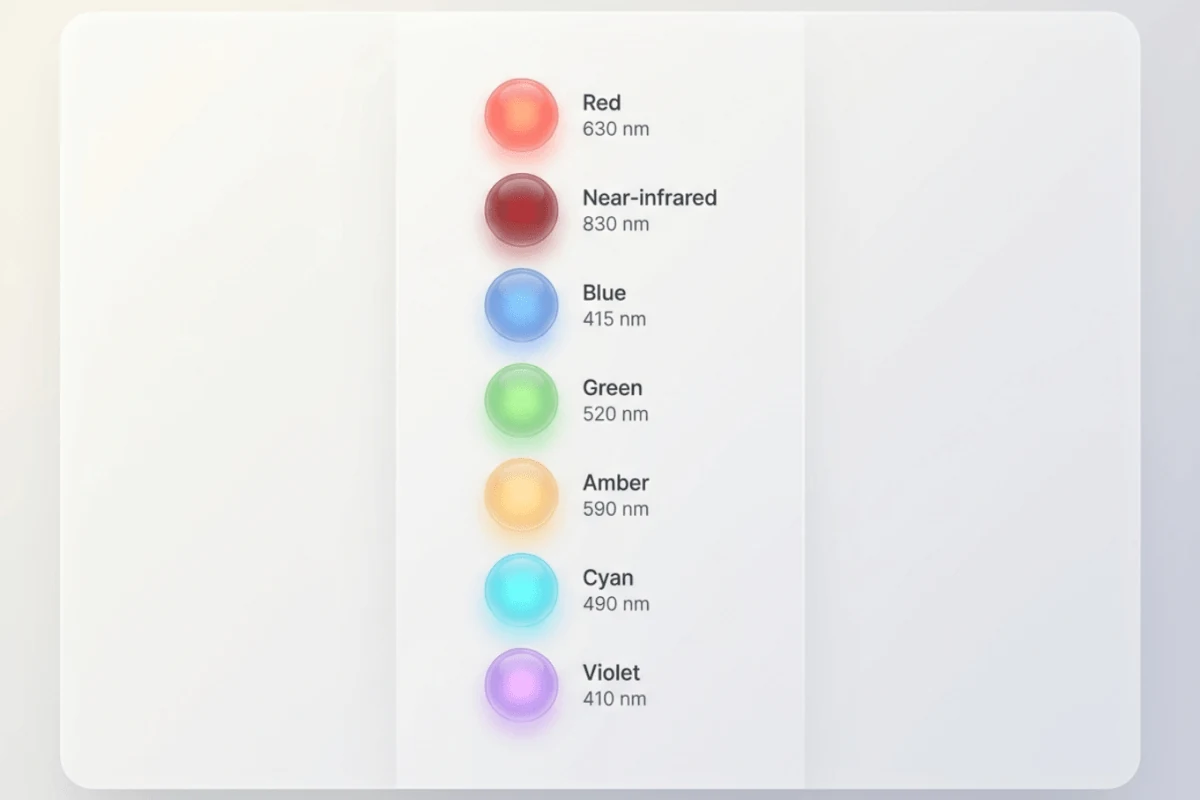
If you have shopped for an LED face device lately, you have almost certainly seen a 7 color LED light therapy chart — a tidy rainbow grid promising that red builds collagen, blue clears acne, green fades dark spots, yellow calms redness, and so on down the spectrum. It looks authoritative and scientific. The problem is that the chart flattens a very uneven evidence base into seven equally confident rows. A few of those colors are backed by randomized controlled trials; others are backed mostly by marketing copy. This guide reproduces the chart honestly: every color, its actual wavelength, and what the science does and does not support, so you can tell the difference between a feature worth paying for and a colorful sticker on the box.
Here is the short version before the detail. The colors are shorthand for wavelengths, measured in nanometers (nm), and wavelength is what determines both how deep the light reaches into skin and which molecules absorb it. Three wavelength bands do the real work: red (around 630-660 nm) and near-infrared (around 830-850 nm) for collagen, wrinkles, and tissue repair, and blue (around 415 nm) for acne. The rest range from “preliminary and plausible” to “there for the chart.” Let’s walk through the whole spectrum.
What a 7 color LED light therapy chart actually shows
A 7 color LED light therapy chart is a summary grid that pairs each visible light color with a claimed skin benefit, but the colors are really placeholders for wavelengths, and it is the wavelength — not the color name — that decides whether the light does anything in your skin. When a device shows white, red, blue, green, yellow, cyan, and purple LEDs, what is physically different between them is the peak wavelength each diode emits. Your eye reads those wavelengths as colors; your skin cells respond to the physics.
Two properties follow directly from wavelength, and both matter more than the marketing label:
- Penetration depth. Longer wavelengths generally reach deeper. Tissue-modeling work shows that penetration rises steadily with wavelength across the visible range: blue is absorbed very close to the surface, while red reaches several millimeters deeper Ash 2017. Near-infrared, longer still, reaches deeper again, which is why blue is an acne tool (it targets bacteria in the surface layers) while near-infrared is the wavelength of interest for muscle and joints.
- Which molecule absorbs it. Light only does something if a chromophore absorbs it. Red and near-infrared are absorbed by cytochrome c oxidase in your mitochondria, kicking off the photobiomodulation cascade that raises cellular energy Hamblin 2017. Blue is absorbed by porphyrins made by acne bacteria. Green, yellow, and cyan do not have a well-established, high-yield chromophore in skin that produces a proven cosmetic result, which is exactly why their evidence is thinner.
There is also the so-called optical window of roughly 600-1000 nm, where longer wavelengths pass through skin more easily and reach deeper into the living dermis where collagen is made Sorbellini 2018. Red and near-infrared sit inside that window. Blue, green, and yellow sit outside it, absorbed nearer the surface. None of this makes the shorter colors useless, but it does explain why the deepest, best-documented effects cluster in the red and near-infrared bands. For the underlying biology, our science page covers photobiomodulation in more depth.
The 7 color LED light therapy chart, color by color
The single most useful thing a color chart can give you is the wavelength behind each color, because that number tells you where the light goes and how strong the evidence is. The table below is the honest version of the chart you see on packaging: same colors, but with the real wavelength ranges and a plain-language evidence rating instead of a confident one-line promise. Wavelength ranges vary a little by manufacturer, and penetration depends on skin tone, hydration, and device power.
| Color | Approx. wavelength | Commonly marketed for | What the evidence actually supports |
|---|---|---|---|
| Blue | ~415 nm | Acne, oil control, breakouts | Good, for acne: photoactivates bacterial porphyrins; strongest when combined with red Papageorgiou 2000 |
| Cyan | ~490-500 nm | Calming, redness, “balancing” | Minimal human evidence; largely promotional |
| Green | ~520-550 nm | Dark spots, pigmentation, calming | Weak and preliminary; no strong controlled trials for skin |
| Yellow / amber | ~570-590 nm | Redness, rosacea, flushing, glow | Limited and emerging; a few small or mechanistic studies |
| Red | ~630-660 nm | Collagen, wrinkles, wound healing | Strong: RCTs show more collagen and fewer wrinkles Wunsch 2014 |
| Near-infrared | ~830-850 nm | Deeper tissue, muscle, recovery | Strong: reaches the deepest layers for rejuvenation and repair Hernandez-Bule 2024 |
| Purple / white | violet blend / full-spectrum | ”All benefits at once” | Blend or marketing; no distinct evidence of its own |
A few notes to read the table well. Purple on most consumer devices is not a special wavelength; it is usually blue and red LEDs running together, so its “benefits” are just the sum of blue and red. White is a broad mix of visible colors and, on its own, has no dedicated skin-rejuvenation evidence. And near-infrared is invisible, so strictly it is not a color at all — but it belongs on any honest chart because it is one of the two best-supported wavelengths in the entire field. A large 2018 clinical review concluded that the three wavelengths with the broadest, best-documented dermatologic applications are blue (around 415 nm), red (around 633 nm), and near-infrared (around 830 nm) — not the full rainbow Ablon 2018. A 2023 review of phototherapy reached the same conclusion, naming blue, red, and near-infrared as the wavelengths that have demonstrated real therapeutic applications Kennedy 2023.
Why red and near-infrared anchor the chart
Red and near-infrared earn the top rows because the evidence is genuinely good, not just abundant. In a randomized, controlled trial of 136 people, red and red-plus-near-infrared light produced statistically significant increases in intradermal collagen density (measured by ultrasound) and objective reductions in skin roughness and wrinkles versus untreated controls Wunsch 2014. The mechanism is well described: photons absorbed by mitochondria raise ATP and signal fibroblasts to build more collagen Avci 2013, and a 2024 comprehensive review identifies red and near-infrared as the workhorse wavelengths for rejuvenation and elasticity Hernandez-Bule 2024. If your goal is anti-aging, texture, or recovery, this is the pair that matters. Our deep dive on why 850 nm penetrates deeper explains the depth advantage of near-infrared, and our collagen results guide covers realistic timelines.
A randomized, controlled trial of 136 people found red and red-plus-near-infrared light produced statistically significant increases in intradermal collagen density and objective reductions in skin roughness and wrinkles versus untreated controls.
Blue light therapy benefits: the one real exception to the red rule
Blue light around 415 nm earns its spot on the chart because it does something red light cannot: instead of energizing your own cells, it photoactivates porphyrins produced by Cutibacterium acnes (formerly Propionibacterium acnes), the bacteria involved in acne. Those porphyrins absorb most strongly between roughly 407 and 420 nm; when blue light hits them, they generate reactive oxygen species that damage the bacteria from the inside Ablon 2018. This is a photodynamic, antibacterial effect, which is why blue is the go-to color for breakouts and oil control rather than for wrinkles.
The clinical picture is encouraging but should be read with care. In a classic randomized trial of 107 patients, combined blue (415 nm) and red (660 nm) light produced a mean 76% improvement in inflammatory acne lesions after 12 weeks, outperforming blue alone, white light, and benzoyl peroxide Papageorgiou 2000. A later LED study combining blue (415 nm) and red (633 nm) reported meaningful clearance in mild-to-severe acne Goldberg 2006. The recurring theme is that blue works best paired with red, not as a solo act.
Now the honest caveat. A systematic review and meta-analysis of 14 randomized trials found the overall evidence for blue light in acne to be promising but methodologically limited, with inconsistent reporting and modest average effects Scott 2019. Translation: blue light is a reasonable, low-risk option for mild-to-moderate acne, especially combined with red, but it is not a guaranteed cure, and it should not replace a dermatologist’s plan for stubborn or cystic acne. If breakouts are your main concern, look for a device that offers a genuine blue channel around 415 nm on top of strong red and near-infrared — not a device that lists “blue” but delivers a weak, off-peak wavelength.
Pros
- Photoactivates bacterial porphyrins to damage acne bacteria
- Reasonable, low-risk option for mild-to-moderate acne
- Works best paired with red light
Cons
- Evidence is promising but methodologically limited, with modest average effects
- Not a guaranteed cure
- Should not replace a dermatologist's plan for stubborn or cystic acne
Green, yellow, cyan, and purple: an honest evidence check
Here is where a color chart usually overpromises, so let’s separate the plausible from the purely promotional. None of these colors is dangerous at normal device intensities; the issue is that the benefit claims run far ahead of the human evidence.
Myth vs fact, color by color:
- Green (~520-550 nm). Marketing says: fades dark spots and hyperpigmentation, calms the mind. Fact: green light is absorbed near the surface and is promoted for pigment, but there are no strong controlled trials showing it reliably lightens melasma or sun spots in the way the charts imply. Some in-office pigment work uses very different laser technology, not gentle LED green. Treat consumer green LED as unproven for pigmentation.
- Yellow / amber (~570-590 nm). Marketing says: erases redness and cures rosacea. Fact: this is the most defensible of the “extra” colors. A handful of small or mechanistic studies suggest yellow light may have anti-inflammatory or anti-redness effects, and it penetrates slightly deeper than green. But the evidence is thin and early compared with red, and yellow is not a substitute for medical rosacea care.
- Cyan (~490-500 nm). Marketing says: soothes and balances skin. Fact: essentially no dedicated human skin-outcome evidence. It sits between blue and green and is largely there to fill a row.
- Purple and white. Marketing says: combines multiple benefits. Fact: purple is typically just blue and red LEDs on at the same time, and white is a broad mix. Neither has independent evidence beyond the individual colors inside it.
The pattern is consistent with the broader literature: comprehensive reviews of LED phototherapy repeatedly single out blue, red, and near-infrared as the wavelengths with real clinical support, while the other colors are noted as emerging or unsupported Ablon 2018, Kennedy 2023. A useful rule of thumb: the more a device leans on the number seven as its headline feature, the more you should check whether its red and near-infrared output is actually strong, because that is where your results will come from. And remember the biphasic dose response — with the wavelengths that do work, more light is not endlessly better; too little does nothing and too much can backfire Hamblin 2017.
The more a device leans on the number seven as its headline feature, the more you should check whether its red and near-infrared output is actually strong, because that is where your results will come from.
7 color LED light therapy: how to use each color
If you already own a 7 color LED light therapy device, you do not need to abandon it — you need to use the colors that earn their keep and set honest expectations for the rest. The colors that reach your skin still follow the same rules of wavelength, dose, and consistency. Here is a practical way to run it.
Step 1: Prep the skin. Cleanse and go bare. Remove makeup and heavy mineral sunscreen first, because pigments and some SPF ingredients can block or scatter light before it reaches the skin. Dry skin, no serums that create a film during the session.
Step 2: Pick the color for your goal, not the whole rainbow.
- Anti-aging, texture, firmness: use red, ideally with near-infrared, as your primary program. This is your workhorse and where the trial evidence lives.
- Active breakouts, oily zones: use blue, and if your device allows, alternate or combine with red — the combination is what the acne trials found most effective Papageorgiou 2000.
- Redness or general “glow”: you can try yellow / amber, but hold your expectations loose; think of it as a gentle add-on, not a treatment.
- Green, cyan, purple: fine to use, but do not expect measurable results, and do not skip your red sessions for them.
Step 3: Dose and schedule. Follow the device’s recommended session length and distance rather than improvising longer sessions. Most home programs run about 10 minutes per area. Consistency is the real active ingredient: the skin trials that worked used sessions several times per week over 8 to 15 weeks before measuring meaningful change Wunsch 2014. Track progress with same-lighting photos every few weeks, not day to day.
Step 4: Protect your eyes. Use the eye protection supplied with the device or keep your eyes closed, especially with bright facial masks. Never stare into the LEDs.
If you are choosing between devices rather than optimizing one you own, our guide to the best red light therapy mask walks through the criteria that actually predict results, and the device finder quiz maps your goals to a recommendation in about two minutes.
Why clinically meaningful masks emphasize red plus near-infrared
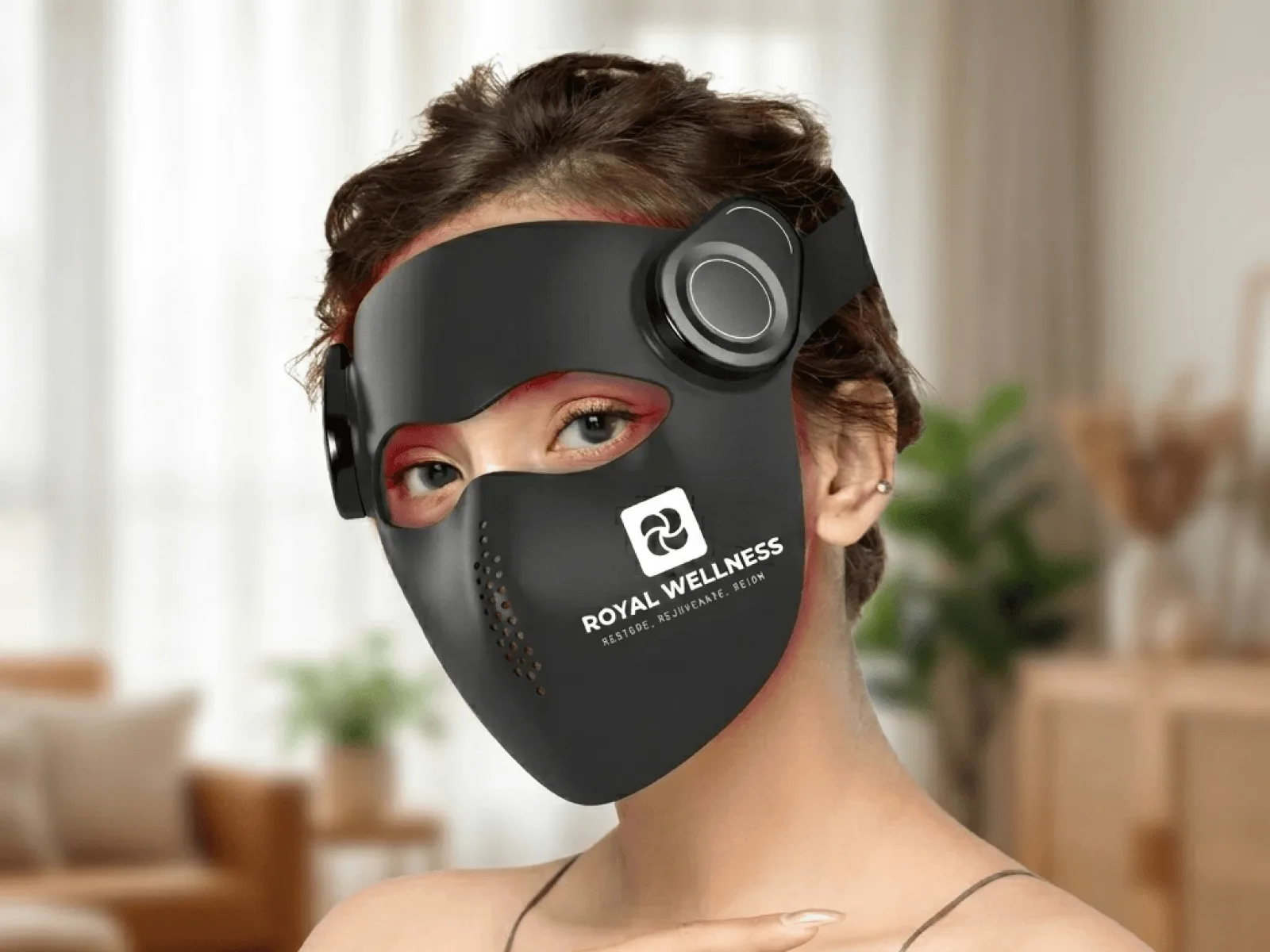
The most credible LED masks are built around red and near-infrared, with any other colors treated as extras rather than the headline — because that is where the controlled-trial evidence sits Hernandez-Bule 2024. A mask’s real advantage over a distant panel is contact and fit: it hugs the face so the light meets your skin evenly with no air gap to weaken the dose. That advantage is only worth having if the wavelengths doing the work are the validated ones. A mask that spreads a weak output across seven colors to win the spec sheet can end up delivering an inadequate red dose, which is the one thing you did not want to compromise.
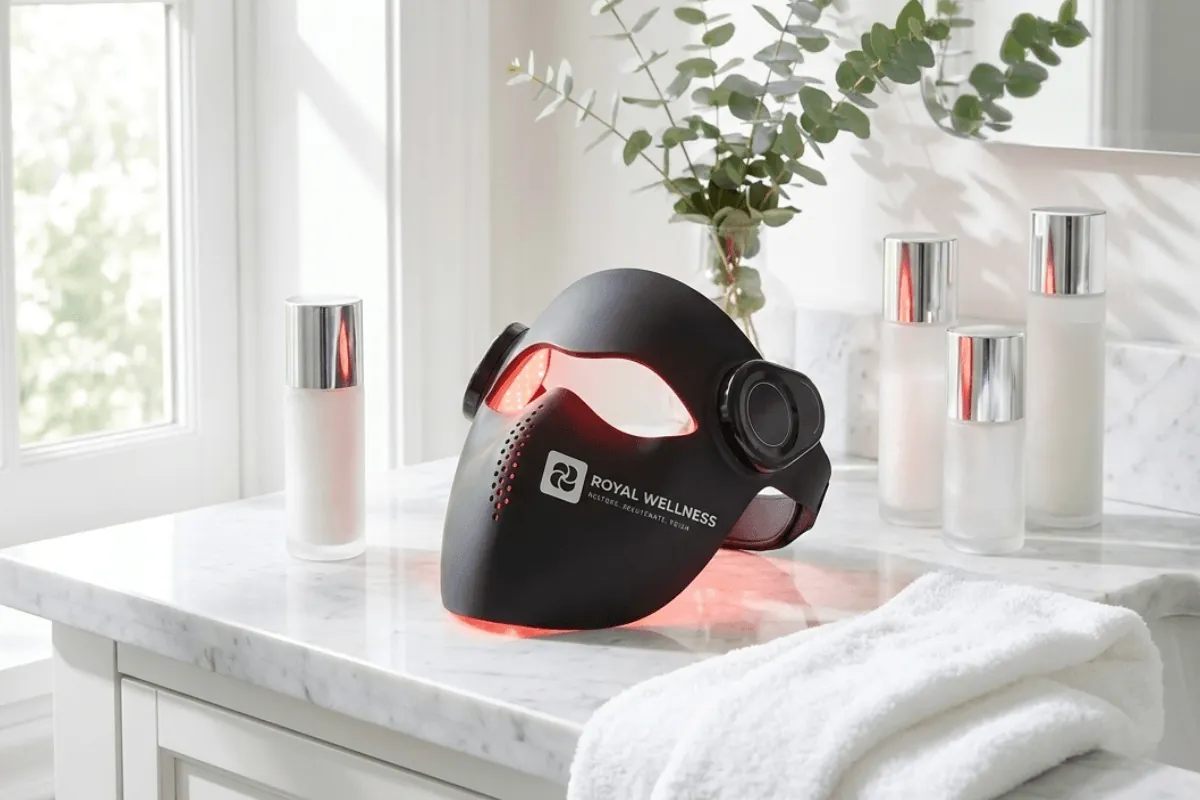
This is the design logic behind the RoyalGLOW Mask. Rather than chasing a seven-color gimmick, it concentrates on the wavelengths with the strongest evidence and adds something most masks cannot: alongside a 460 nm LED for surface concerns, it delivers red and near-infrared as laser at 665 nm, 850 nm, and 1064 nm across 288 diodes, cordless. Coherent laser light lets the device push validated red and near-infrared wavelengths into the skin at a controlled dose, which is a more meaningful upgrade than adding a green or cyan channel with little evidence behind it. In other words, it optimizes the rows of the chart that matter instead of maximizing the number of rows. You can compare it against other facial devices on our masks page or browse the full shop, and our panel vs mask vs belt guide helps if you are still deciding on a form factor.
Safety: who should check with a clinician first
Red, near-infrared, and blue LED light therapy are generally well tolerated, and trials report few or no serious adverse effects, in part because these are non-UV wavelengths that do not carry the DNA-damage risk of tanning Avci 2013. Still, several groups should be cautious or get medical clearance before starting any color of LED therapy:
- Pregnancy. Safety data during pregnancy are limited; talk to your provider first.
- Photosensitizing medications. Some antibiotics (tetracyclines, fluoroquinolones), certain diuretics, some antidepressants and antipsychotics, and oral acne drugs such as isotretinoin can make skin more light-reactive. If a medication is labeled for photosensitivity, get clearance.
- Prescription retinoids on the treated skin. Retinoids can thin and sensitize the surface and are associated with photosensitivity; ask your dermatologist about timing.
- Active melasma or pigment disorders. Because melasma can be triggered or worsened by light and heat, people with active melasma should be cautious — which is another reason to be skeptical of green or yellow LED marketed as a melasma fix — and consult a dermatologist.
- Photosensitive conditions. Lupus, porphyria, or a history of light-triggered rashes warrant medical advice first.
- Eyes. Blue light in particular, and bright facial masks in general, call for eye protection or a closed-eye protocol. Do not stare into the LEDs.
If any of these apply to you, a quick conversation with your doctor or dermatologist before you begin is the safe path.
The bottom line
A 7 color LED light therapy chart is a marketing frame, not a hierarchy of equally proven benefits. Read it through the lens of wavelength and evidence and it collapses to a much simpler picture: red (around 630-660 nm) and near-infrared (around 830-850 nm) are the well-supported wavelengths for collagen, wrinkles, and recovery; blue (around 415 nm) has a real, more modest role for acne, best combined with red; and green, yellow, cyan, and purple range from preliminary to promotional. Realistic expectations matter too — even with the proven wavelengths, results are gradual and depend on consistent use over weeks to months, not a single glowing session.
So do not buy a device for the length of its color list. Buy it for strong, validated red and near-infrared output at an adequate dose, with a genuine blue channel if acne is on your list. That is exactly the priority behind the RoyalGLOW Mask, which concentrates on the wavelengths the evidence backs — red and near-infrared, delivered as laser at 665, 850, and 1064 nm — instead of padding a spec sheet with colors that mostly fill a chart. Compare your options in the shop, read the underlying studies in our research library, or take the quiz to match your goals to the right device in about two minutes.
- A 7 color LED light therapy chart maps each color to a skin benefit, but color is just shorthand for wavelength, and wavelength is what decides how deep light travels and whether it does anything at all.
- Only three bands carry robust clinical evidence: red (around 630-660 nm) and near-infrared (around 830-850 nm) for collagen, wrinkles, and tissue repair, and blue (around 415 nm) for acne.
- Green, yellow or amber, cyan, and purple or white are largely preliminary or promotional; small or mechanistic studies exist, but nothing on the level of the randomized trials behind red and blue.
- Blue light works by a different route than red: it photoactivates porphyrins inside acne bacteria rather than energizing your own cells, and it performs best combined with red light.
- For anti-aging and recovery, a device that delivers validated red plus near-infrared at an adequate dose beats a device that offers more colors but weaker output on the wavelengths that matter.
- Skip or get medical clearance first if you are pregnant, take photosensitizing medication, use prescription retinoids on treated skin, or have active melasma, and always protect your eyes.
FREQUENTLY ASKED
What is a 7 color LED light therapy chart?
It is a summary grid, common on device packaging and product pages, that lists seven light colors (typically red, blue, green, yellow or amber, cyan, purple, and sometimes white or near-infrared) and pairs each with a claimed skin benefit. The chart is a marketing convenience: the real driver of any effect is the wavelength in nanometers behind each color, and the evidence behind the seven rows is very uneven. Red, near-infrared, and blue have solid clinical support; the others are mostly preliminary or promotional.
Which LED light color is best for anti-aging and wrinkles?
Red light around 630 to 660 nm, often combined with near-infrared around 830 to 850 nm, has the strongest evidence for collagen and wrinkles. Randomized controlled trials show these wavelengths increase intradermal collagen density and measurably reduce fine lines and roughness. Near-infrared penetrates deeper than visible red, which is why quality anti-aging devices pair the two rather than relying on any of the other colors on the chart.
Do green, yellow, and cyan LED light actually work?
The honest answer is that the evidence is thin. Yellow or amber light (around 570 to 590 nm) has a handful of small studies suggesting anti-inflammatory or anti-redness effects, and green (around 520 to 550 nm) is promoted for pigmentation, but neither has the randomized-trial support of red or blue. Cyan and purple sit closer to pure marketing. They are unlikely to harm you, but you should not choose a device based on how many of these colors it lists.
What are the benefits of blue light therapy?
Blue light around 415 nm is used mainly for mild to moderate acne. It is absorbed by porphyrins produced by Cutibacterium acnes (formerly Propionibacterium acnes), triggering reactive oxygen species that damage the bacteria. Controlled trials show the strongest results when blue is combined with red light, with one trial reporting about a 76% improvement in inflammatory lesions. A systematic review found the overall evidence encouraging but methodologically limited, so treat blue light as a supportive option, not a guaranteed acne cure.
Is near-infrared one of the 7 colors on the chart?
Sometimes. Near-infrared (around 830 to 850 nm) is invisible to the eye, so it is not a color in the literal sense, but many charts include it because it is one of the best-supported wavelengths for deeper tissue, muscle, and joint effects. On seven-color charts, near-infrared often replaces one of the weaker visible colors, or is bundled with red. If a chart lists seven visible colors and no near-infrared at all, the device may be skewing toward marketing rather than the wavelengths that do the most work.
Should I buy a device with more colors or one focused on red and near-infrared?
For skin aging and recovery, a device focused on validated red and near-infrared at an adequate dose will usually outperform a device that spreads a weaker output across seven colors. More colors look impressive on a chart but do not add proven benefit if the core red and near-infrared output is compromised. If acne is a specific concern, look for a device that adds a genuine blue channel around 415 nm on top of strong red and near-infrared.
REFERENCES
- 1. Ablon G. Phototherapy with Light Emitting Diodes: Treating a Broad Range of Medical and Aesthetic Conditions in Dermatology. J Clin Aesthet Dermatol. 2018;11(2):21-27. PMID:29552272 (PMC5843358)
- 2. Kennedy R. Phototherapy as a Treatment for Dermatological Diseases, Cancer, Aesthetic Dermatologic Conditions and Allergenic Rhinitis in Adult and Paediatric Medicine. Life (Basel). 2023;13(1):196. doi:10.3390/life13010196 (PMC9864074)
- 3. Scott AM, Stehlik P, Clark J, et al. Blue-Light Therapy for Acne Vulgaris: A Systematic Review and Meta-Analysis. Ann Fam Med. 2019;17(6):545-553. doi:10.1370/afm.2445 (PMC6846280)
- 4. Papageorgiou P, Katsambas A, Chu A. Phototherapy with blue (415 nm) and red (660 nm) light in the treatment of acne vulgaris. Br J Dermatol. 2000;142(5):973-978. doi:10.1046/j.1365-2133.2000.03481.x (PMID:10809858)
- 5. Goldberg DJ, Russell BA. Combination blue (415 nm) and red (633 nm) LED phototherapy in the treatment of mild to severe acne vulgaris. J Cosmet Laser Ther. 2006;8(2):71-75. doi:10.1080/14764170600735912 (PMID:16766484)
- 6. Wunsch A, Matuschka K. A Controlled Trial to Determine the Efficacy of Red and Near-Infrared Light Treatment in Patient Satisfaction, Reduction of Fine Lines, Wrinkles, Skin Roughness, and Intradermal Collagen Density Increase. Photomed Laser Surg. 2014;32(2):93-100. doi:10.1089/pho.2013.3616 (PMC3926176)
- 7. Hamblin MR. Mechanisms and applications of the anti-inflammatory effects of photobiomodulation. AIMS Biophys. 2017;4(3):337-361. doi:10.3934/biophy.2017.3.337 (PMC5523874)
- 8. Avci P, Gupta A, Sadasivam M, et al. Low-level laser (light) therapy (LLLT) in skin: stimulating, healing, restoring. Semin Cutan Med Surg. 2013;32(1):41-52. PMID:24049929 (PMC4126803)
- 9. Ash C, Dubec M, Donne K, Bashford T. Effect of wavelength and beam width on penetration in light-tissue interaction using computational methods. Lasers Med Sci. 2017;32(8):1909-1918. doi:10.1007/s10103-017-2317-4 (PMC5653719)
- 10. Sorbellini E, Rucco M, Rinaldi F. Photodynamic and photobiological effects of light-emitting diode (LED) therapy in dermatological disease: an update. Lasers Med Sci. 2018;33(7):1431-1439. doi:10.1007/s10103-018-2584-8 (PMC6133043)
- 11. Hernandez-Bule ML, Naharro-Rodriguez J, Bacci S, Fernandez-Guarino M. Unlocking the Power of Light on the Skin: A Comprehensive Review on Photobiomodulation. Int J Mol Sci. 2024;25(8):4483. doi:10.3390/ijms25084483 (PMC11049838)
- 12. de Freitas LF, Hamblin MR. Proposed mechanisms of photobiomodulation or low-level light therapy. IEEE J Sel Top Quantum Electron. 2016;22(3):7000417. PMID:28070154 (PMC5215870)
ABOUT THE AUTHORS
Our team reviews the peer-reviewed literature on red and near-infrared light therapy and translates it into honest, practical guidance — no hype, just what the evidence actually supports.