Shark CryoGlow vs Omnilux vs CurrentBody vs RoyalGLOW: LED Face Mask Comparison
Shark CryoGlow vs Omnilux vs CurrentBody vs RoyalGLOW: a spec-by-spec LED face mask comparison of wavelengths, LEDs, laser, FDA clearance, and price.
LED face masks have gone mainstream, and the four names you keep running into are Omnilux, CurrentBody, Shark, and RoyalGLOW. They look similar on the shelf, but they are priced from about $350 to $800 and differ in ways that actually change your results. The most common cross-shop is Shark CryoGlow vs Omnilux, followed closely by whether the pricier CurrentBody or the laser-equipped RoyalGLOW is worth the jump. This guide puts all four side by side on the specs that matter — wavelengths, diode count, LED versus laser, session time, FDA clearance, and price — and tells you, honestly, which one fits which buyer.
Here is the short version. Every mask on this page relies on the same core biology: red light near 630-660 nm and near-infrared near 830 nm, absorbed by your skin’s cells to support collagen. That science is well established and does not change from brand to brand. What changes is how much light each mask delivers, which extra wavelengths it adds, how it fits your face, and what you pay. If you want the deeper mechanism, our guide to realistic collagen results covers it; here we stay focused on picking between these four devices.
How the four LED masks compare at a glance
The single most useful way to compare LED face masks is a flat spec table, because marketing language hides the numbers that decide dose and fit. Below are the four masks on the specs buyers actually cross-shop. Prices are as of 2026 and vary by retailer and promotion, so verify current pricing before you buy.
| Mask | Wavelengths | Light sources | LED vs laser | Session | FDA status | Price (2026) |
|---|---|---|---|---|---|---|
| RoyalGLOW (RoyalPRO Mask) | 460 nm blue LED + 665 / 850 / 1064 nm laser | 288 diodes | LED + laser | Cordless guided program | Confirm regulatory status with seller | ~$799 |
| Omnilux Contour Face | 633 nm red + 830 nm NIR | 132 LEDs (66 bulbs) | LED | 10 min, 3-4x/week | FDA 510(k) cleared (fine lines/wrinkles) | ~$395 |
| CurrentBody Skin Series 2 | 633 nm red + 830 nm NIR + 1072 nm deep NIR | 236 LEDs | LED | ~10 min | FDA 510(k) cleared (full-face wrinkles) | ~$470 |
| Shark CryoGlow | 630 nm red + 830 nm NIR + blue (~415 nm) + under-eye cooling | 480 sources (160 tri-wick LEDs) | LED | 4-8 min LED modes + 5-15 min cooling | FDA 510(k) cleared (fine lines, acne) | ~$350 |
A few honest caveats before you read too much into any single row. Diode counts are not directly comparable across brands, because a “tri-wick LED” (Shark) bundles three emitters in one package, while other brands count bulbs or individual diodes differently. Irradiance and “power density” numbers are even messier: brands measure them with different instruments at different distances, and consumer-grade solar meters typically read higher than a lab spectrometer. Treat the raw numbers as a rough guide, not gospel — the specs below matter most when they change what the mask can actually do.
Shark CryoGlow vs Omnilux: which anti-aging mask wins?
For pure anti-aging pedigree, Omnilux edges out the Shark CryoGlow — but the CryoGlow answers a different question and costs less. This is the head-to-head most shoppers land on, so it deserves the most detail.
The Omnilux red light mask (the Contour Face) is the clinical-heritage choice. It uses two validated wavelengths, 633 nm red and 830 nm near-infrared, delivered across 132 medical-grade LEDs, and it is FDA 510(k) cleared for reducing fine lines and wrinkles. Crucially, Omnilux backs its wrinkle claims with a published clinical study: 25 participants aged 30-65 used the mask three times a week for 10 minutes over four weeks, with the brand reporting improvements in firmness and the appearance of fine lines. That is a real, if small, study on the actual device — a step above the generic “LED works” hand-waving many masks lean on. The wavelength pairing itself is squarely in the range that controlled trials support for collagen and wrinkle reduction Lee 2007, Wunsch 2014.
The Shark CryoGlow LED face mask takes a broader, more feature-driven approach at a lower price (around $350). It delivers red (630 nm) and near-infrared (830 nm) like Omnilux, but adds two things Omnilux does not have. First, a blue wavelength (reported around 415 nm; verify on the current listing) aimed at blemishes — blue light is the band used against acne-associated bacteria rather than for collagen Sorbellini 2018. Second, its signature InstaChill under-eye cooling, a genuinely unique feature that temperature-controls the under-eye area to soothe and temporarily de-puff. The CryoGlow runs several short guided modes (roughly 4-8 minutes for the LED programs, plus an adjustable 5-15 minute under-eye cooling cycle) and is FDA 510(k) cleared for both fine lines and acne.
So who wins the Shark CryoGlow vs Omnilux debate? Decide by goal:
- Choose Omnilux if your single priority is firming, collagen, and fine lines, and you want the mask with a published study on the exact device. It does one job and does it with the cleanest evidence.
- Choose Shark CryoGlow if you want more for less: acne-oriented blue light, a soothing under-eye cooling feature nobody else offers, and the lowest price of the four. It is the better all-rounder for combination or blemish-prone skin.
Neither is a bad buy. They simply optimize for different faces. If your skin concern is strictly anti-aging, the extra features on the Shark are pleasant but beside the point; if you juggle breakouts and puffiness too, the CryoGlow does more per dollar.
Neither is a bad buy. They simply optimize for different faces.
CurrentBody Skin Series 2: the higher-dose, multi-wavelength option
If you want a higher-dose red light mask vs Omnilux, the CurrentBody Skin Series 2 is the most direct upgrade. It is the mask for people who looked at Omnilux, liked the science, and wanted more of it.
The CurrentBody Skin LED light therapy mask (Series 2) carries 236 LED bulbs — nearly double Omnilux’s 132 — arranged as 110 red (633 nm), 110 near-infrared (830 nm), and 16 deep near-infrared (1072 nm) diodes. That third wavelength is the headline difference: 1072 nm sits deeper in the near-infrared than the 830 nm most masks stop at, and longer near-infrared wavelengths are modeled to penetrate further into tissue Ash 2017. CurrentBody quotes a power density around 30 mW/cm² with a convenient 10-minute session, a flexible silicone shape, and added nose, lip, and chin coverage. The Series 2 (model MK-90H) is FDA 510(k) cleared for full-face wrinkles.
The trade-off is price. At roughly $470 it is the most expensive of the three mainstream LED masks here, about $75 more than Omnilux and $120 more than the Shark. What you are paying for is more diodes, more coverage, and a deeper wavelength — a bigger, more thorough dose of light on more of your face per session. Whether that translates into visibly better outcomes than a validated 633/830 nm mask is not something any head-to-head trial has cleanly proven, so set expectations honestly: this is a well-specified premium LED mask, not a categorically different technology.
Choose the CurrentBody Series 2 if coverage and dose are your priorities, you want the deep 1072 nm wavelength, and the higher price does not bother you. If you would rather not pay for LEDs and coverage you may not need, Omnilux remains the leaner clinical option, and the Shark undercuts both on price.
RoyalGLOW: the only LED-plus-laser mask (665/850/1064 nm)
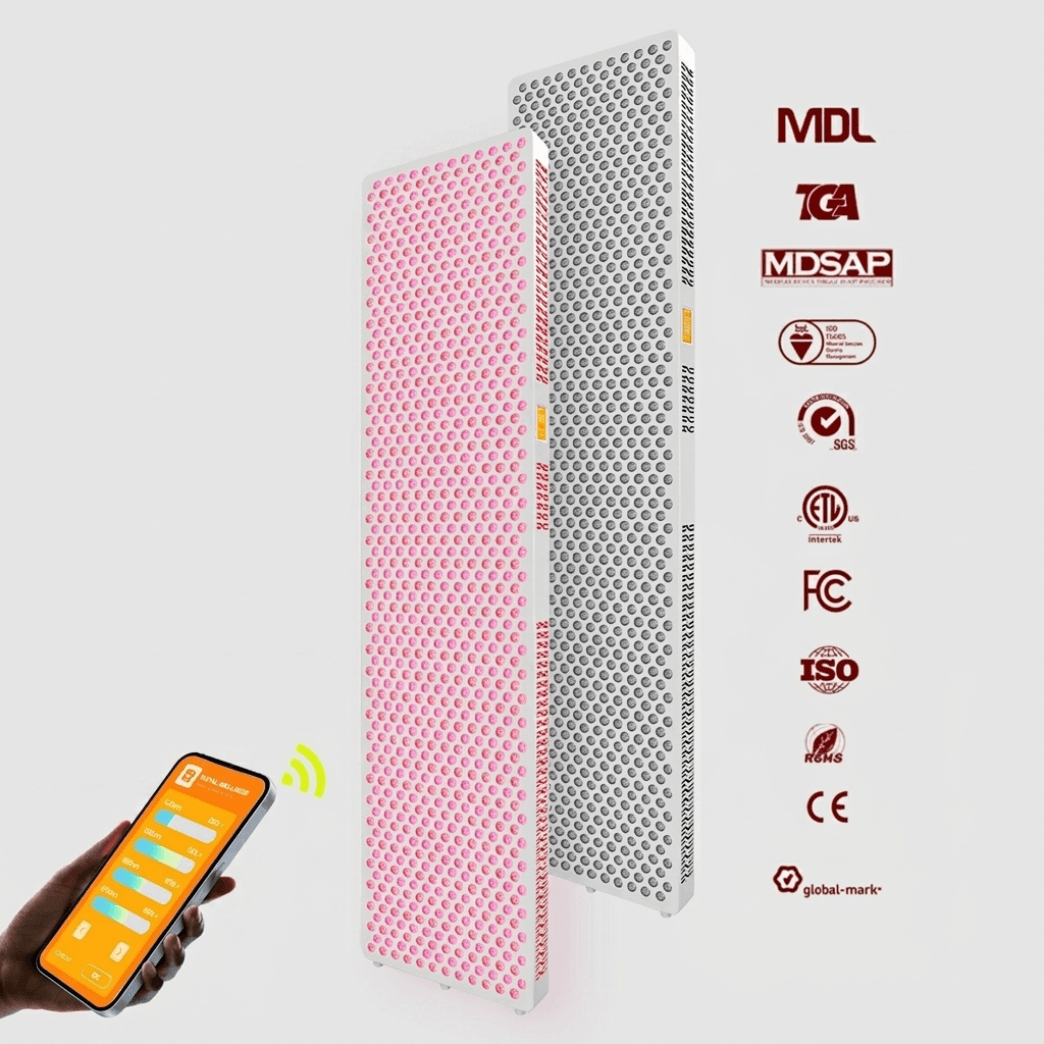
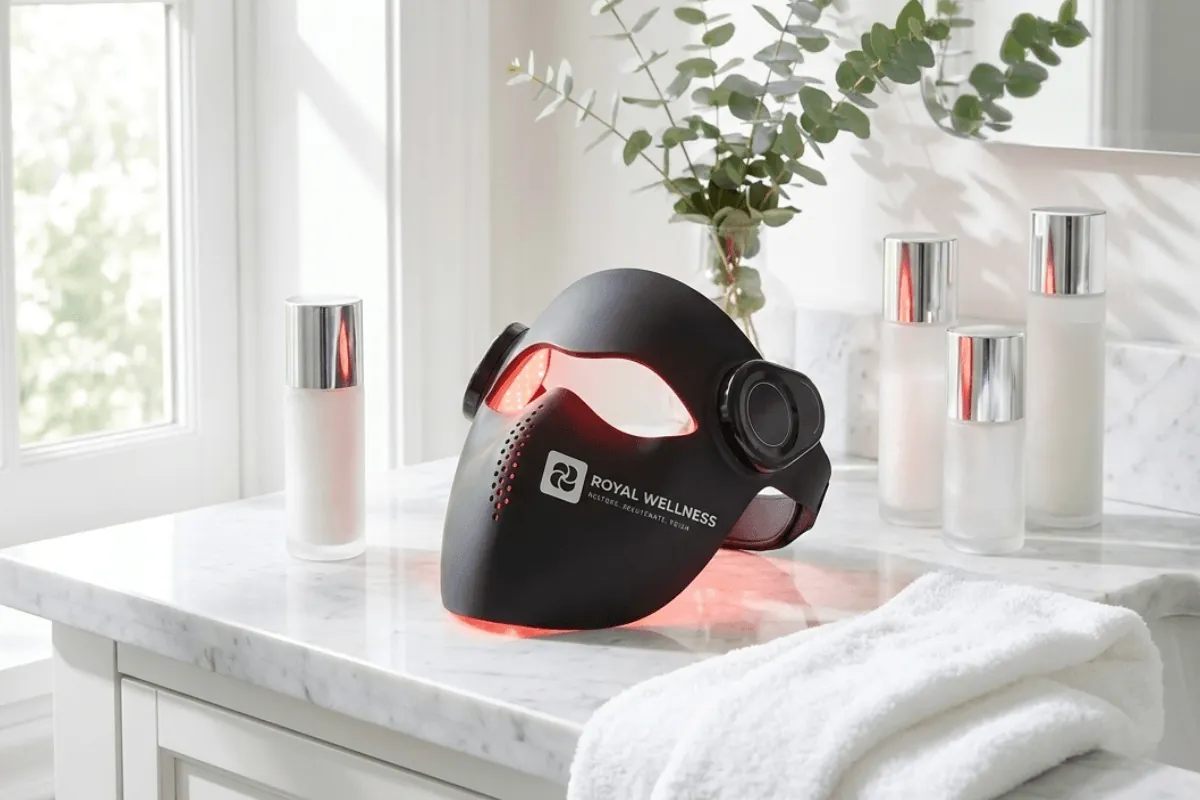
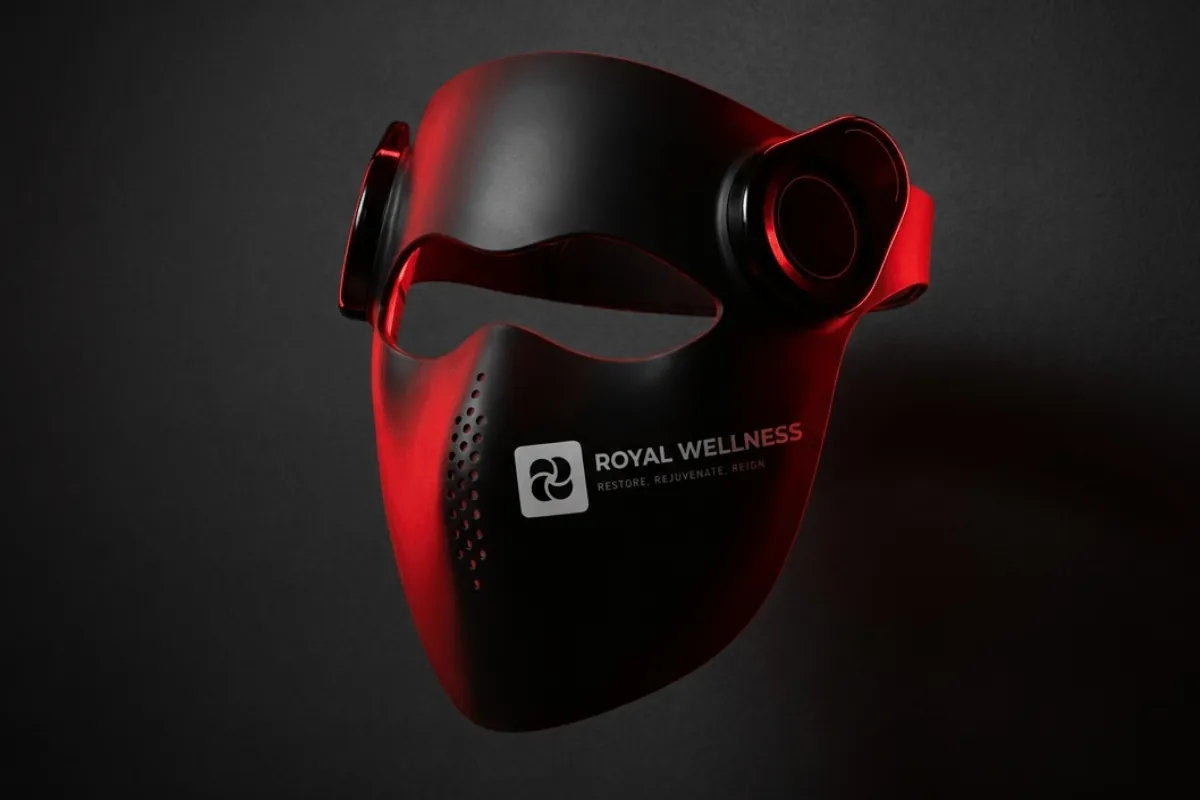
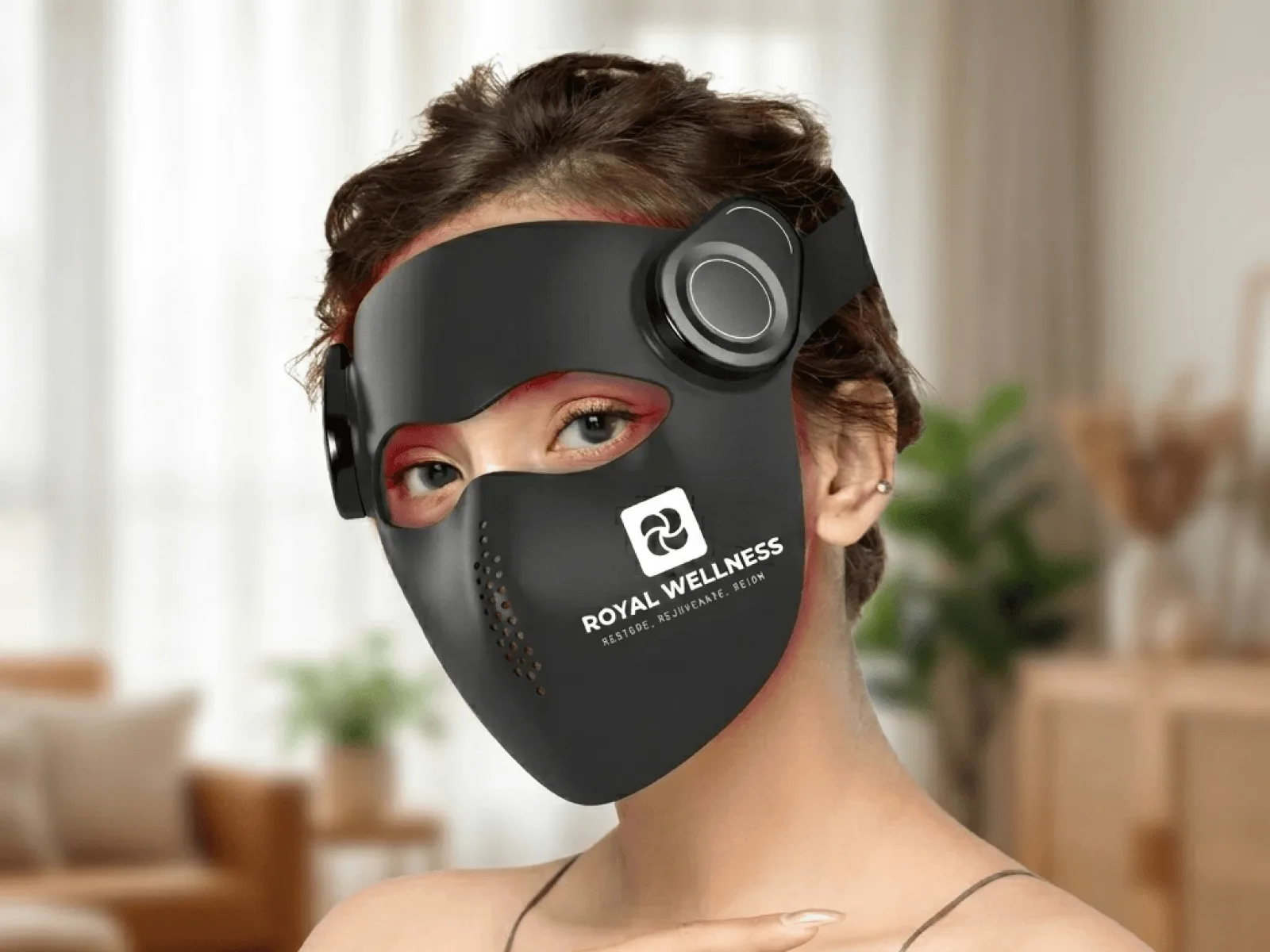
RoyalGLOW is the only mask in this comparison that pairs LEDs with medical-style laser diodes, which is its central point of difference. Where Omnilux, CurrentBody, and Shark are all pure-LED devices, the RoyalGLOW mask combines a 460 nm blue LED with 665 nm, 850 nm, and 1064 nm laser diodes across 288 total emitters, cordless.
Two things make that meaningful. First, the wavelength spread is the widest here: a blue LED for blemish-oriented light, 665 nm red and 850 nm near-infrared in the core collagen band, and a 1064 nm laser reaching into the deep near-infrared — comparable in depth intent to CurrentBody’s 1072 nm, but delivered as coherent laser light rather than LED. Second, laser diodes emit coherent, tightly focused light that can concentrate higher intensity on the tissue than a comparable LED, which is why RoyalGLOW sits at a professional tier (around $799) rather than the mainstream $350-470 band.
Now the honest framing, because this matters for a truthful purchase decision. The bulk of the peer-reviewed skin-rejuvenation evidence — the collagen density and wrinkle studies — was generated with LED sources, not lasers Wunsch 2014, Barolet 2009, Couturaud 2023. Reviews of photobiomodulation generally conclude that coherence is not required for the core mitochondrial effect, and that both LEDs and lasers can drive the same underlying photobiomodulation cascade Hamblin 2017, Avci 2013. So the truthful positioning of a laser mask is: a premium, higher-output, wider-wavelength tool that can deliver more intensity — not a device that has “proven” itself superior to a good LED mask in a controlled trial. If you are stepping up from a starter LED mask and want the most capable device with the broadest wavelength set, RoyalGLOW is the pro pick. If you want the shortest, evidence-backed path to the core anti-aging effect, a validated LED mask does that job for a third of the price.
One regulatory note applies to any laser device: confirm the current clearance status and the eye-safety class directly with the seller, and use the supplied eye protection without exception. Laser light demands more caution around the eyes than diffuse LED light.
Wavelengths, dose, and coherence: what actually drives results
Across all four masks, three variables — wavelength, dose, and consistency — decide your results far more than the brand on the box. Understanding them lets you read any mask’s spec sheet critically.
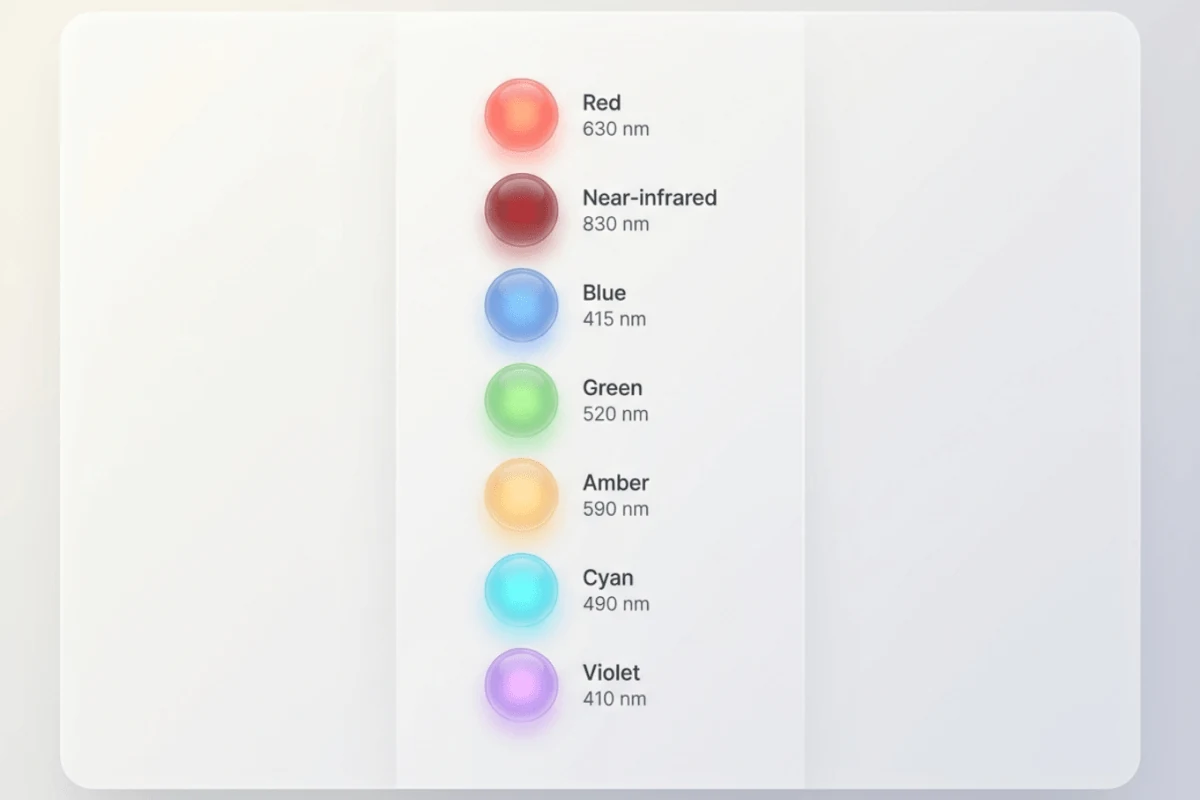
Wavelength sets what the light does and how deep it goes. Visible red around 630-660 nm is absorbed in the upper-to-mid dermis where collagen-producing fibroblasts live; near-infrared around 830-850 nm penetrates deeper; and the deep near-infrared band (1064-1072 nm on the RoyalGLOW and CurrentBody) reaches deeper still Ash 2017. Blue light (415-460 nm on the Shark and RoyalGLOW) barely penetrates and is used against acne-associated bacteria, not for collagen Sorbellini 2018. The workhorse anti-aging bands are red and near-infrared; everything else is a targeted add-on. A 2024 comprehensive review reaches the same conclusion, naming red and NIR as the primary wavelengths for collagen, elasticity, and rejuvenation Hernandez-Bule 2024. Our 7-color LED light therapy chart breaks down what each color is actually for, and the science page covers the mechanism in depth.
Dose is intensity multiplied by time, and it follows a biphasic curve: too little does nothing, an appropriate amount stimulates cells, and far too much can be counterproductive Hamblin 2017. This is why a bigger, brighter mask is not automatically better, and why “more minutes” is not a valid protocol — each of these masks runs a fixed program for a reason. It is also why cross-brand irradiance numbers are treacherous: without a stated measurement method and distance, a high mW/cm² figure is closer to marketing than to a delivered dose de Freitas 2016.
Intensity multiplied by time, following a biphasic curve: too little does nothing, an appropriate amount stimulates cells, and far too much can be counterproductive.
Coherence is the laser-versus-LED question. Lasers emit coherent, monochromatic light; LEDs emit a diffuse spread. Coherent light can pack more intensity onto a spot, which is the technical case for RoyalGLOW. But for photobiomodulation in skin, the mitochondrial target responds to the photons regardless of coherence, and the strongest clinical dataset was built on LEDs. The practical read: coherence is a genuine engineering difference and a reason a laser mask can output more, not a guarantee of a better wrinkle outcome.
The uncomfortable truth for all four brands is that the biggest driver of your result is not on any spec sheet: it is whether you actually use the mask two to five times a week for 8-12 weeks, the window in which controlled trials measured change Wunsch 2014, Mota 2023. A $350 mask worn nightly beats an $800 mask that lives in a drawer.
Photobiomodulation reduces periocular wrinkle volume by 30%.
How to choose: match the mask to your goal
The right mask is the one that fits your primary skin goal, your budget, and the routine you will actually keep. Work through these steps rather than chasing the highest number.
- Step 1 — Name your primary goal. Firming and fine lines only? Any of the four works; Omnilux is the leanest evidence-backed option. Breakouts too? Prioritize a mask with blue light (Shark CryoGlow or RoyalGLOW). Puffy under-eyes a pain point? Only the Shark’s cooling addresses that directly.
- Step 2 — Set your budget band. Around $350: Shark CryoGlow. Around $395-470: Omnilux or CurrentBody. Around $800 for a pro-tier, laser-equipped device: RoyalGLOW.
- Step 3 — Decide how much dose and coverage you want. More diodes, deeper wavelengths, and fuller face coverage point to CurrentBody (236 LEDs, 1072 nm) or RoyalGLOW (288 diodes, laser). Leaner, validated, and simple points to Omnilux.
- Step 4 — Check fit and routine. A flexible silicone mask (CurrentBody, RoyalGLOW) contours better than a rigid shell for some faces; a shorter guided session is easier to keep up. The best mask is the one you will use consistently.
- Step 5 — Confirm the fine print. Verify current price, the exact FDA 510(k) clearance language, eye protection, and — for the laser RoyalGLOW — regulatory and eye-safety details with the seller.
If you would rather have this narrowed for you, take the quiz to map your skin goals to a device, or read our dedicated ranking of the best red light therapy masks for the criteria in depth. For the broader form-factor question — mask versus panel versus belt — see our form-factor guide, and browse the full lineup under masks.
Safety
LED and laser face masks are well tolerated for most healthy adults, but a few situations call for a clinician check first. Red and near-infrared light are non-UV, so they do not carry the DNA-damage risk of tanning, and trials consistently report few or no adverse effects Wunsch 2014. Still, take these precautions:
- Eyes. Always use the supplied eye protection or keep your eyes closed, and never stare into the diodes. This matters most for the laser-equipped RoyalGLOW, where coherent light warrants extra caution; confirm its eye-safety class with the seller.
- Pregnancy. Safety data for red light therapy in pregnancy is limited; talk to your provider before use.
- Photosensitizing medication. Some antibiotics (tetracyclines, fluoroquinolones), diuretics, certain antidepressants, and oral acne drugs like isotretinoin increase light sensitivity. Get clearance if you take anything labeled photosensitizing.
- Retinoids on treated skin. Retinoids can thin and sensitize the stratum corneum and are themselves linked to photosensitivity Ferguson 1986. Many people separate retinoid nights from light sessions; ask your dermatologist about combining them.
- Active melasma or photosensitive conditions. Because light and heat can aggravate melasma, and conditions like lupus or porphyria react to light, consult a dermatologist first.
None of these masks is a treatment for any disease. They are wellness devices supported by encouraging cosmetic evidence — use them as one part of a routine that also includes sun protection and sensible skincare.
The bottom line
There is no universal “best” LED face mask, only the best fit for your goal and budget. Omnilux is the clean, clinically studied anti-aging pick at around $395. Shark CryoGlow is the value all-rounder at around $350, with blue light and a genuinely unique under-eye cooling feature — which is why the Shark CryoGlow vs Omnilux decision usually comes down to whether you want extra features or the leanest evidence. CurrentBody Skin Series 2 is the higher-dose, deeper-wavelength upgrade at around $470. And RoyalGLOW is the only LED-plus-laser mask, a pro-tier device with the widest wavelength set (460 nm LED plus 665/850/1064 nm laser across 288 diodes) at around $799.
Be honest with yourself about what you will actually use, because consistency over 8-12 weeks beats any spec on paper. If you want the most capable, widest-wavelength device and you are ready to invest at the professional tier, the laser-and-LED build of the RoyalGLOW mask is the ceiling of this category — it closes the intensity and wavelength gap the mainstream LED masks leave open. If you are still deciding between tiers, compare the full range under masks or let the quiz match a device to your skin goals in about two minutes.
- All four masks work on the same core science: red (around 630-633 nm) and near-infrared (around 830 nm) light to support collagen. The real differences are dose, extra wavelengths, form factor, and price, not the underlying biology.
- Omnilux Contour Face is the clinical-pedigree pick (633/830 nm, published wrinkle study, FDA cleared, ~$395). Shark CryoGlow is the value pick with unique under-eye cryo cooling plus blue light for blemishes (~$350).
- CurrentBody Skin Series 2 pushes a higher dose across the most LEDs of the mainstream masks (236 diodes) and adds 1072 nm deep near-infrared, at a higher price (~$470).
- RoyalGLOW is the only mask here that pairs LED with medical-style laser diodes (460 nm LED plus 665/850/1064 nm laser across 288 diodes), a pro-tier build at ~$799.
- Match the mask to your goal: cross-shopping anti-aging usually comes down to Shark CryoGlow vs Omnilux, while deeper penetration and higher output push you toward CurrentBody or RoyalGLOW.
- Whatever you buy, results are gradual over 8-12 weeks, eye protection matters, and photosensitizing medication, retinoids, pregnancy, or active melasma warrant a clinician check first.
FREQUENTLY ASKED
Shark CryoGlow vs Omnilux: which LED face mask is better?
It depends on your goal. Omnilux Contour Face is the stronger pure anti-aging pick: it uses validated 633 nm red and 830 nm near-infrared wavelengths and has a published clinical study behind its wrinkle claims, at about $395. Shark CryoGlow is the better all-rounder for the money at about $350, because it adds blue light for blemishes and a genuinely unique under-eye cryo-cooling feature no other mask offers. If your only priority is firming and fine lines, Omnilux; if you want acne support, puffy-eye soothing, and a lower price, Shark CryoGlow.
Is the CurrentBody Skin mask worth more than Omnilux?
CurrentBody Skin Series 2 costs more (around $470 vs $395) and gives you more in return: 236 LEDs versus Omnilux's 132, plus a third 1072 nm deep near-infrared wavelength Omnilux does not have. If you want a higher-dose red light mask vs Omnilux and value deeper-penetrating light and full nose-and-chin coverage, the CurrentBody upgrade is defensible. If you only care about the core anti-aging wavelengths and want the leanest clinically studied option, Omnilux still does the essential job for less.
What wavelengths do these LED face masks use?
Omnilux uses 633 nm red and 830 nm near-infrared. CurrentBody Skin Series 2 uses 633 nm, 830 nm, and 1072 nm deep near-infrared. Shark CryoGlow uses 630 nm red, 830 nm near-infrared, and a blue wavelength (reported around 415 nm; verify on the listing) plus under-eye cooling. RoyalGLOW uses a 460 nm blue LED alongside 665 nm, 850 nm, and 1064 nm laser diodes. The 630-660 nm and 830-850 nm bands are the workhorses for collagen; the deep 1064-1072 nm and blue wavelengths are add-ons.
Does a laser mask like RoyalGLOW beat LED masks?
Lasers deliver coherent, higher-intensity light, and RoyalGLOW is the only mask in this comparison to use laser diodes (665/850/1064 nm) alongside a 460 nm LED across 288 diodes. That can mean higher delivered intensity. Be honest about the evidence, though: most published skin-rejuvenation trials used LEDs, and reviews suggest coherence is not essential for photobiomodulation in skin. A laser mask is a premium, higher-output tool; it is not automatically better than a well-dosed LED mask for every goal.
Are these LED face masks FDA approved?
None are FDA approved; that term is reserved for a different, stricter pathway. Omnilux Contour Face, CurrentBody Skin Series 2, and Shark CryoGlow are FDA 510(k) cleared, meaning the FDA reviewed them as substantially equivalent to existing devices for uses like reducing fine lines and wrinkles (and, for Shark, acne). Cleared is not the same as approved. Always confirm the current regulatory status and eye-safety class of any device, especially a laser device, directly with the seller before buying.
How long until I see results from an LED face mask?
Plan on weeks, not days. Controlled trials on red and near-infrared light for skin generally ran 4 to 15 weeks with sessions two to five times per week before measuring meaningful change in wrinkles, firmness, and texture. Omnilux's own study measured results at four weeks with three sessions a week; most people notice brighter skin first and firmer, smoother skin over 8 to 12 weeks. Consistency matters far more than which brand you pick.
Can I use an LED mask if I am pregnant or use retinoids?
Talk to a clinician first. There is limited safety data on red light therapy in pregnancy, so get provider clearance. Retinoids and several photosensitizing medications (some antibiotics, diuretics, and acne drugs like isotretinoin) can make skin more light-reactive; many people separate retinoid nights from light sessions and check with a dermatologist about combining them. Active melasma, photosensitive conditions, and eye conditions also warrant medical advice before you start.
REFERENCES
- 1. Wunsch A, Matuschka K. A controlled trial to determine the efficacy of red and near-infrared light treatment in patient satisfaction, reduction of fine lines, wrinkles, skin roughness, and intradermal collagen density increase. Photomed Laser Surg. 2014;32(2):93-100. doi:10.1089/pho.2013.3616 PMC3926176
- 2. Lee SY, Park KH, Choi JW, et al. A prospective, randomized, placebo-controlled, double-blinded, and split-face clinical study on LED phototherapy for skin rejuvenation. J Photochem Photobiol B. 2007;88(1):51-67. doi:10.1016/j.jphotobiol.2007.04.008 PMID 17566756
- 3. Barolet D, Roberge CJ, Auger FA, Boucher A, Germain L. Regulation of skin collagen metabolism in vitro using a pulsed 660 nm LED light source: clinical correlation with a single-blinded study. J Invest Dermatol. 2009;129(12):2751-2759. doi:10.1038/jid.2009.186 PMID 19587693
- 4. Couturaud V, Le Fur M, Pelletier M, Granotier F. Reverse skin aging signs by red light photobiomodulation. Skin Res Technol. 2023;29(7):e13391. doi:10.1111/srt.13391 PMC10311288
- 5. Mota LR, Duarte IDS, Galache TR, et al. Photobiomodulation reduces periocular wrinkle volume by 30%: a randomized controlled trial. Photobiomodul Photomed Laser Surg. 2023;41(2):48-56. doi:10.1089/photob.2022.0114 PMID 36780572
- 6. Avci P, Gupta A, Sadasivam M, et al. Low-level laser (light) therapy (LLLT) in skin: stimulating, healing, restoring. Semin Cutan Med Surg. 2013;32(1):41-52. PMC4126803
- 7. Hamblin MR. Mechanisms and applications of the anti-inflammatory effects of photobiomodulation. AIMS Biophys. 2017;4(3):337-361. doi:10.3934/biophy.2017.3.337 PMC5523874
- 8. Hernandez-Bule ML, Naharro-Rodriguez J, Bacci S, Fernandez-Guarino M. Unlocking the power of light on the skin: a comprehensive review on photobiomodulation. Int J Mol Sci. 2024;25(8):4483. doi:10.3390/ijms25084483 PMC11049838
- 9. Sorbellini E, Rucco M, Rinaldi F. Photodynamic and photobiological effects of light-emitting diode (LED) therapy in dermatological disease: an update. Lasers Med Sci. 2018;33(7):1431-1439. doi:10.1007/s10103-018-2584-8 PMC6133043
- 10. Ash C, Dubec M, Donne K, Bashford T. Effect of wavelength and beam width on penetration in light-tissue interaction using computational methods. Lasers Med Sci. 2017;32(8):1909-1918. doi:10.1007/s10103-017-2317-4 PMC5653719
- 11. de Freitas LF, Hamblin MR. Proposed mechanisms of photobiomodulation or low-level light therapy. IEEE J Sel Top Quantum Electron. 2016;22(3):7000417. doi:10.1109/JSTQE.2016.2561201 PMC5215870
- 12. Ferguson J, Johnson BE. Photosensitivity due to retinoids: clinical and laboratory studies. Br J Dermatol. 1986;115(3):275-283. doi:10.1111/j.1365-2133.1986.tb05741.x PMID 3530309
ABOUT THE AUTHORS
Our team reviews the peer-reviewed literature on red and near-infrared light therapy and translates it into honest, practical guidance — no hype, just what the evidence actually supports.